Climate Change Archives - Facilities Management Forum | Forum Events Ltd
Posts Tagged :

Climate Change

IPCC climate report focuses on built environment solutions

There are multiple, feasible and effective options to reduce greenhouse gas emissions and adapt to human-caused climate change, and they are available now, say scientists in the latest Intergovernmental Panel on Climate Change (IPCC) report.

“Mainstreaming effective and equitable climate action will not only reduce losses and damages for nature and people, it will also provide wider benefits,” said IPCC Chair Hoesung Lee. “This Synthesis Report underscores the urgency of taking more ambitious action and shows that, if we act now, we can still secure a liveable sustainable future for all.”

The report, approved during a week-long session in Interlaken, brings in to sharp focus the losses and damages we are already experiencing and will continue into the future, hitting the most vulnerable people and ecosystems especially hard. Taking the right action now could result in the transformational change essential for a sustainable, equitable world, says the report.

“Climate justice is crucial because those who have contributed least to climate change are being disproportionately affected,” said Aditi Mukherji, one of the 93 authors of this Synthesis Report, the closing chapter of the Panel’s sixth assessment.

“Almost half of the world’s population lives in regions that are highly vulnerable to climate change. In the last decade, deaths from floods, droughts and storms were 15 times higher in highly vulnerable regions,” she added.

Resilient development

This involves integrating measures to adapt to climate change with actions to reduce or avoid greenhouse gas emissions in ways that provide wider benefits.

For example: access to clean energy and technologies improves health, especially for women and children; low-carbon electrification, walking, cycling and public transport enhance air quality, improve health, employment opportunities and deliver equity. The economic benefits for people’s health from air quality improvements alone would be roughly the same, or possibly even larger than the costs of reducing or avoiding emissions.

Climate resilient development becomes progressively more challenging with every increment of warming. This is why the choices made in the next few years will play a critical role in deciding our future and that of generations to come.

To be effective, the report says, these choices need to be rooted in our diverse values, worldviews and knowledges, including scientific knowledge, Indigenous Knowledge and local knowledge. This approach will facilitate climate resilient development and allow locally appropriate, socially acceptable solutions.

“The greatest gains in wellbeing could come from prioritizing climate risk reduction for low-income and marginalised communities, including people living in informal settlements,” said Christopher Trisos, one of the report’s authors. “Accelerated climate action will only come about if there is a many-fold increase in finance. Insufficient and misaligned finance is holding back progress.”

Sustainable development

There is sufficient global capital to rapidly reduce greenhouse gas emissions if existing barriers are reduced. Increasing finance to climate investments is important to achieve global climate goals. Governments, through public funding and clear signals to investors, are key in reducing these barriers. Investors, central banks and financial regulators can also play their part.

There are tried and tested policy measures that can work to achieve deep emissions reductions and climate resilience if they are scaled up and applied more widely. Political commitment, coordinated policies, international cooperation, ecosystem stewardship and inclusive governance are all important for effective and equitable climate action.

If technology, know-how and suitable policy measures are shared, and adequate finance is made available now, every community can reduce or avoid carbon-intensive consumption. At the same time, with significant investment in adaptation, we can avert rising risks, especially for vulnerable groups and regions.

Climate, ecosystems and society are interconnected. Effective and equitable conservation of approximately 30-50% of the Earth’s land, freshwater and ocean will help ensure a healthy planet. Urban areas offer a global scale opportunity for ambitious climate action that contributes to sustainable development.

Changes in the food sector, electricity, transport, industry, buildings and land-use can reduce greenhouse gas emissions. At the same time, they can make it easier for people to lead low-carbon lifestyles, which will also improve health and wellbeing. A better understanding of the consequences of overconsumption can help people make more informed choices.

“Transformational changes are more likely to succeed where there is trust, where everyone works together to prioritise risk reduction, and where benefits and burdens are shared equitably,” Lee said. “We live in a diverse world in which everyone has different responsibilities and different opportunities to bring about change. Some can do a lot while others will need support to help them manage the change.”

Extreme heat in the workplace: How to keep factory & warehouse staff safe and comfortable

With England experiencing its first ever red warning for extreme heat this week, raised temperatures in the workplace have the potential to become a health and safety issue as employers struggle to keep working areas within the recommended temperatures.

In line with this concern, the Trades Union Congress (TUC) has called for a legally enforceable limit, suggesting a maximum temperature of 30C for regular indoor work and 27C for strenuous work.

The TUC says employers should act to bring down temperatures if they exceed 24C, however.

Slingsby, one of the UK’s leading suppliers of industrial and commercial equipment, has some simple and practical tips on how employers can keep factory and warehouse staff safe and comfortable at work during the soaring temperatures of the current heatwave:

  1. Check air conditioning and ventilation units are working at their optimum level – there may not be time to install new systems, but some quick maintenance checks could make all the difference. If more localised air cooling is required, in the case where conditioning systems are not adequate or, air conditioning systems are not installed within industrial environments, then a combination of fans, mobile air coolers and evaporative air coolers can be adopted.
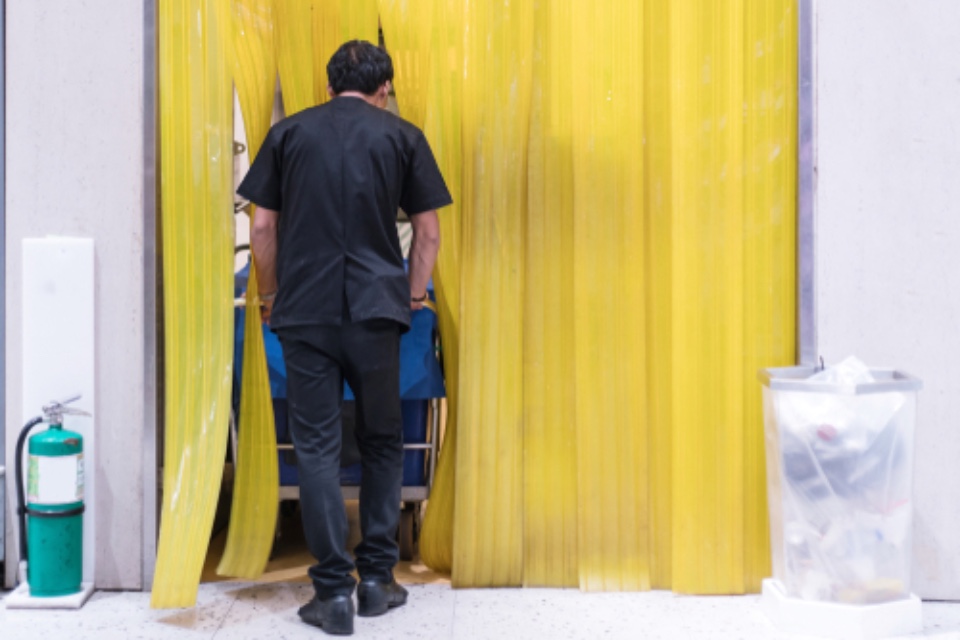
  2. Place plastic PVC strip curtains over open building entrances to help block out harmful UV rays and maintain temperatures.
  3. Solar-control window film can be installed quickly and will work to deflect the sun’s heat, especially on windows that you know receive a lot of direct sunlight. This method can help to reduce your reliance on air-conditioning and work to save on your energy bills.
  4. Keep machinery and electrical equipment switched off overnight and when not in use. Heavy machinery generates a lot of heat, and this will help to bring down the room temperature of your warehouse or factory floor. Placing signage near machinery to remind workers to ‘switch off when not in use’ could prove helpful too.
  5. Adding water coolers to communal areas can help staff members stay cool and hydrated.
  6. Encourage employees to take cover away from the direct sunlight during lunch and smoking breaks. Create additional temporary shaded areas outside with parasols if you have the space.
  7. Monitor room temperatures across the different areas of your workplace with thermometers.
  8. During heatwaves and throughout the summer, the pollen count may be high and so, it is worth considering investing in air purifiers for your working environment, to help ensure employees are comfortable, especially those with hay fever.

Open Innovation Levels Framework published by UKGBC

The UK Green Building Council (UKGBC) and Sustainable Ventures (SV) have published the Open Innovation Levels Framework, a resource aimed at enabling open innovation with the goal of reducing the climate impacts of the built environment.

The organisations say 40% of UK carbon emissions are attributable to the built environment, which requires significant innovation to reduce its impact. Recent research shows that, in London, innovation is the most frequently identified soft skill required to respond to recent trends in the built environment, with the same research identifying the most significant trend being the climate crisis.

As part of a project to accelerate open innovation, funded by EIT Climate-KIC, UKGBC and SV carried out interviews, desktop research and workshops with innovators and large corporations operating in the built environment sector to identify the needs and barriers currently preventing significant innovation. This research identified that in many cases the power to overcome barriers to innovation lies with large corporate organisations.

45% of all barriers identified related to corporate culture, including attitude to risk, lack of systems thinking and lack of incentives.

The Framework provides a step-by-step guide on how corporates can engage in open innovation and reach effective solutions. It is divided into 4 key phases – challenge definition, scoping, engagement, and collaboration – each of which are broken down further into 8 levels with associated actions. This shared process creates a common understanding of open innovation between corporates and innovators, increases transparency, and enables more efficient and timely engagements.

Alastair Mant, Head of Business Transformation at UKGBC said: “If the built environment is to play its part in tackling the climate crisis we must radically increase the use of innovative solutions. Many companies throughout the property and construction value chain are setting ambitious carbon reduction commitments and to meet these they must now find new ways to construct and operate buildings and infrastructure. Innovators and start-ups continue to create many of the required concepts, prototypes and even final products, but due to largely cultural issues, take-up of these solutions is too slow. The Open Innovation Levels Framework provides corporates with a step-by-step process for collaborating with start-ups in a way that will lead to greater levels of innovation within their projects and across the industry.

“It is our hope that UKGBC members and other organisation in the built environment find this Framework useful in pursuing innovative solutions to environmental and social impact challenges.”

Charlie Beharrell, Senior Commercial Associate at Sustainable Ventures, added: “Sustainable Venture’s community is thriving with innovators tackling the Built Environment’s climate and sustainability issues, but the sector lags behind in its efforts to nurture these and bring them to market. The framework we have developed with UKGBC will enable corporate entities to better engage with early stage innovation, helping to build new, tailored solutions to facilitate the transition to net zero.”

Don’t let COVID-19 wreck your climate change plans

By Onsite Energy Projects

We all need to refocus on the big issue of climate change, but we are facing a significant recession in the next few years. I predict that capex budgets are going to evaporate, and as a result investment plans are going to be put on hold. The consequence could be to derail our climate change and sustainability plans for some years to come.

At the same time, saving money has never been more important – to be competitive and grow jobs.  So how can you keep up the pace of sustainability gains, energy savings and make your business more competitive ?

Never has there been a better time to look at our zero capex, off-balance sheet solution.  We can help with energy savings ideas, sustainability innovation and develop the business cases for energy efficiency measures.  We can deliver them as an energy supply agreement without any cost to you.  All you need to do is pay for the power we provide (at a discount to what you are paying for grid power).

There is no cost to you for our analysis and recommendations.  We have experience in delivering solutions for complex manufacturing environments. We can particularly add value where you have a lot of use of heat, steam, chill or air conditioning.

In short we can accelerate your plans, not have them beaten back by lack of capital caused by COVID-19.

If you would like to know more email us at info@on-site.energy or call on 0161 444 9989.

Onsite Energy Projects provides energy savings and energy generation solutions to energy intensive businesses, without capex if required.

Scotland leads the UK in energy and climate change…

New analysis compiled by the government’s climate watchdog, the Committee on Climate Change (CCC) has discovered that Scotland is leading the UK when it comes to lowering emissions; detailing that its annual greenhouse gas reduction target was met in 2014 and gross emissions fell by 8.6 per cent during that period – compared to a reduction of 7.3 per cent recorded for the UK as a whole.

The ‘Reducing emissions in Scotland – 2016 progress report’ also acknowledges that emissions in Scotland have decreased by almost 40 per cent over the past 30 years – in comparison to 33 per cent for the UK – and CCC members also revealed that Scotland has shown great enthusiasm in introducing renewable electricity generation, as well as implementing a ‘well developed’ energy efficiency policy and making ‘excellent progress’ with community energy schemes.

Chair of the CCC, Lord Deben, said in a statement: “Scotland continues to lead the UK both in performance and ambition when it comes to tackling climate change. Emissions are reducing and the latest targets have been hit.”

Despite the positive action, the CCC has also warned that more work needs to be done following warnings from the Energy and Climate Change Select Committee that the UK will more than likely miss an EU-set target that is legally binding to achieve 15 per cent of its energy from renewable sources by the year 2020. 


Read the full analysis here