Energy Archives - Page 3 of 4 - Facilities Management Forum | Forum Events Ltd
Posts Tagged :

Energy

CASE STUDY: The Restaurant Group – Energy Reduction Strategy

By Alan Little, Business Development Manager, ECA Group

The Restaurant Group Plc (TRG) is a significant player in the UK casual dining market, operating over 500 restaurants and pubs which include Frankie and Benny’s, Chiquito, Coast to Coast, Garfunkel’s, Firejacks, Brunning & Price and Joe’s Kitchen.

They also operate a concession business which trades over 60 outlets across more than 30 brands, primarily in UK airports.

One of TRG’s core principals is sustainability and as such a decision was taken in 2013 to implement an energy management programme to reduce wastage across all sites.

ECA manage TRG’s entire portfolio and provide energy procurement, bill validation, compliance and energy management services.

ECA’s Approach

ECA created a strategy to monitor and highlight energy wastage which included regular and detailed consumption analysis, tailored reporting, remote management of exceptions directly with sites, site surveys and behavioural change sessions.

Historic consumption data was analysed against operational hours and other site benchmarks to create profile targets for each meter and site. Monitoring of HH & AMR data on a daily basis using profile usage alarms detected consumption outside targeted thresholds.

These were investigated by speaking directly to site staff to determine the cause and put measures in place to prevent recurrence.

Where a cause could not be established remotely a site survey was arranged to investigate possible causes and rectify issues on site where possible.

Some of the issues that were regularly identified included, broken equipment, misunderstanding of how to use equipment settings for the best effect, and general wastage behaviours such as having equipment on when it is not required.

ECA also attended local and national group events to deliver energy saving tips and advice to TRG staff.

Results

ECA has provided its Virtuous Energy reduction service since 2013 and has achieved year on year savings averaging 5.3% against a target of 2.5%. Last year (2017) we achieved savings of around £500K.

ECA Group – TRG Group Service supplier of the Year

In July this year ECA were awarded service supplier of the year, a fantastic achievement as they were selected from over 100 suppliers.

ECA are still providing this service to TRG and we expect further savings going forwards.

GUEST BLOG: Clamping down on your business’ energy costs in 2018

By Flogas

Energy bills are becoming a bigger focus for businesses around Britain — with the average organisation spending around £4,000. Becoming energy aware (and energy smart) can not only help businesses boost their bottom line, it can also dramatically reduce their carbon footprint – making for a more profitable, greener company all round.

The cost businesses are facing

Cost has changed over time, which has led to this newly found focus on energy supply. For most SMEs, gas and electricity charges now make up a considerable chunk of their monthly outgoings – taking a hefty portion of their profits. The majority of UK businesses are using between 15,000 and 25,000 kWh of power per year, but annual consumption figures for large business and industry can reach in excess of 250,000 kWh.

How will this impact the final bill? The latest data shows that businesses in the UK are spending an average of £3,061 on their annual electricity bills, and an additional £856 a year on gas. Small businesses in particular fare slightly better – but with the average electricity bill for an SME reaching £2,958 (and that’s before putting business mains gas into the equation), it’s still a considerable outlay.

A plan for cost reduction

Many industries will benefit from the right energy supplier and there are plenty ways to create a plan.

  1. Becoming more aware of your energy use

Before you make any core decisions around your energy plan, you must assess how much you actually use and how much it is currently costing you. The average unit prices in the UK are currently 14.36p per kWh for electricity and 4.25p per kWh for gas, with standing charges on top of this. Finding out your business’s annual usage figures – and knowing when your contract is due to come to an end – means you’re well equipped to accurately compare your current supplier’s prices with others on the market.

  1. Look at a range of energy suppliers

Research into other energy suppliers too. Ahead of your contract ending, it’s worth finding out how much switching could save you. And, whether you use a broker, online search or go direct, make sure you don’t limit yourself to the Big Six. Switching to a smaller business energy supplier could mean significantly lower bills, and benefits like better customer service.

  1. Analyse your current contract agreement

There’s plenty of energy suppliers willing to give you a better deal, so make sure you look at your current one before any renewals. For example, an extended fixed-term contract could help protect you against future price rises, giving some valuable peace of mind and making budgeting easier. Or there might be an additional discount on offer if you opt for a Direct Debit payment plan.

  1. Get a smart meter

Talk to your supplier about fitting a smart meter. That way you’ll know exactly how much your business energy supply is costing you day-to-day – and because you only pay for what you use, there’s no need for estimated billing or meter readings. As well as saving on monthly charges, it can also help you wise up to your company energy use and make better decisions on where you might be able to curb your consumption. Energy management software can also help provide useful insight for larger businesses.

  1. Find out where your energy is being used

There’s always room for improvement when it comes to your business’ energy use. It could be as simple as making sure computers are switched off outside of office hours, or putting your lights on a timer, but encouraging employees to find more efficient ways of working is a great place to start. Some companies even introduce incentive schemes to help foster better habits, offering staff tangible rewards for greener behaviour.

  1. Save

Always think of the bigger picture when it comes to energy consumption and try investing in equipment that understands the importance of efficient energy use.  While this approach might come with a heftier price tag in the first instance, any piece of kit that helps save energy on your everyday operations will pay for itself and more in the long run.

*Statistics from BusinessEnergy.com and article brought to you by gas mains supplier, Flogas.

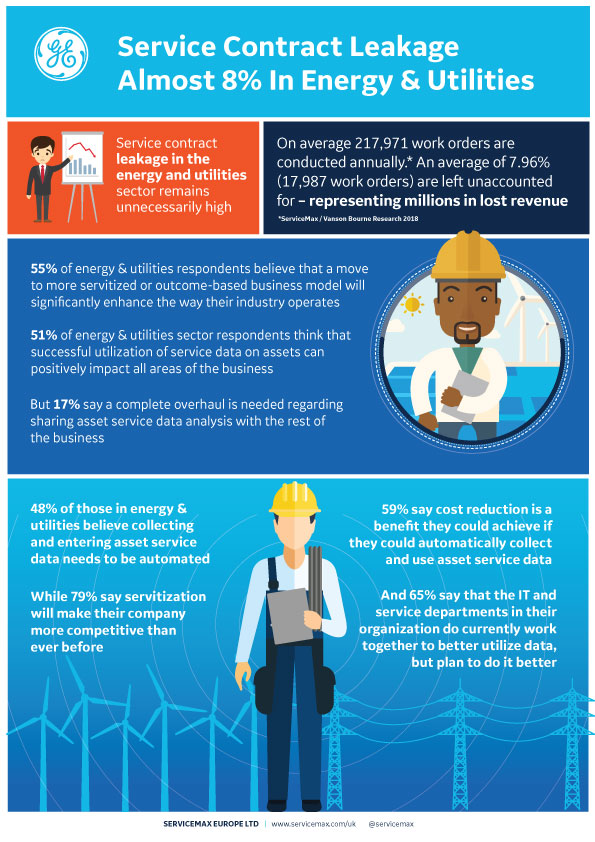
INFOGRAPHIC: Energy & utilities sector suffering from 8% service contract leakage

On average, 17,987 work orders are unaccounted for annually – representing millions in lost revenue.

That’s according to a new piece of global research, “The Rise of Asset and Service Data Gravity”, conducted by Vanson Bourne, commissioned by field service management specialist, ServiceMax from GE Digital, which asserts that service contract leakage in the energy and utilities sector remains unnecessarily high.

In addition to missing service work orders, representing millions in lost revenue across the industry, the report says there’s a growing desire for the Energy and Utilities sector to move to servitizstion – also known as outcome-based services.

By integrating services with products, it says, companies can create bundles that are of greater value than products alone.

Here’s the full infographic:


MPower UPS

INDUSTRY SPOTLIGHT: MPower UPS Takes Power Protection to the Next Level 

Availability continues to be a major concern for data center managers and those working in other critical environments.

Leading provider of uninterruptible power supplies, MPower UPS, has joined forces with CENTIEL to market CumulusPower for the first time in the UK.

CumulusPower  is a three-phase modular UPS system which offers continuous power availability through its fault-tolerant Distributed Active Redundant Architecture (DARA) which removes single points of failure and is now available exclusively through MPower UPS.

MPower’s dedicated team is excited now to introduce this solution to existing and new customers, taking power protection to the next level across the globe.

Electricity Pylon

New energy technology plan to ‘save UK £40bn’

A plan to give homes and businesses more control over their energy use and support innovative new technologies as part of the Industrial Strategy has been outlined by Ofgem and Business & Energy Secretary Greg Clark.

The proposal aims to transform how homes and businesses store and use energy, removing barriers to smart technology and ultimately reducing costs for end-users – something that will be discussed in depth at the Energy Management Summit in October.

The report, ‘Upgrading Our Energy System’ says over a quarter of the UK’s electricity is already being generated through renewables such as wind and solar, much of it located close to homes and businesses.

Meanwhile, new technologies that help store and manage energy are emerging and the costs are falling.

Regulator Ofgem says changes provide an opportunity to create new businesses and jobs in the UK. At the same time new technologies like smart meters, along with other improvements to manage the energy system will help the country save up to £40bn on energy costs over decades to come.

As part of the Industrial Strategy, the Government has committed to modernising the UK’s energy system and developing a business environment where new entrants to the market can compete. This, it says, will also allow industry to develop innovative new products and services, creating thousands of jobs.

The plan will also make it easier for new businesses to help customers that are interested in reducing, or increasing, their energy use at certain times, which can help balance the calls on the electricity network.

Business and Energy Secretary Greg Clark said: “Upgrading our energy system to make sure it is fit for the future is a key part of our Industrial Strategy to deliver a smarter, more flexible energy system. A smarter energy system will create new businesses and high-skilled jobs, while making sure our infrastructure is able to cope with demand.

“It’s an important part of our Industrial Strategy, given its potential to reduce energy costs, increase productivity, and put UK businesses in a leading position to export smart energy technology and services to the rest of the world.”

By rolling out smart meters, enabling suppliers to offer lower tariffs and making it easier for firms to develop smart appliances and gadgets, the plan will help consumers use energy when it is cheapest or get rewarded for returning it to the grid when it is needed.

The plan also recognises the role that energy storage can play in a smart energy grid and the opportunities presented by falling costs of battery technologies designed to store surplus energy. To allow industry to exploit these new technologies Government and Ofgem have committed to removing barriers to the introduction of this technology into our power network.

Andrew Wright, Senior Partner, Energy Systems, Ofgem, said: “The way we are generating and using energy in Britain is changing rapidly. Today’s plan sets out how Ofgem, Government and the industry will work together to modernise the energy system and make sure consumers get the benefits of the changes.

“We want to open the door to new technologies and services so that they can help to reduce bills for consumers in the long term. It is vital that we get the changes in place as there is potential for a smarter system to save consumers billions between now and 2050.”

The full implementation of the plan to move to a smarter energy system alongside other changes could help save the country up to £40bn over the coming decades, according to research conducted for BEIS by Imperial College and the Carbon Trust.


Lloyds Energy to create 700 jobs in liquid gas trade

Lloyds Energy Group LLC has submitted a formal application to export Liquefied Natural Gas (LNG) to countries with a Free Trade Agreement (FTA) with the US, creating a large number of jobs in the process.

Production involves extreme compression of natural gas, often methane, in order to improve the transportation process. The volume in a liquid state is 600 times less than in a gaseous form.

Exporting from their facility in Calhoun County, Texas, the project will be known as Point Comfort LNG and aims to significantly benefit the south central Texas coastal region, in part in the creation of around 700 direct, long-term jobs.

Lloyds Energy expects the project to also indirectly lead to thousands more jobs, as well as economic benefits and a predicted hundreds of millions of dollars in revenue.

“Lloyds Energy is strongly positioned to meet client demand, and submitting our Point Comfort LNG FTA application is an important first step towards making the final investment decision,” said Philip Holland, Lloyds Energy CEO. “The U.S. has an abundant supply of natural gas and the international market has a growing demand for cleaner, more-efficient fuel.”

 The company hopes to expand further into new territories, and with a potential new deal between the US and UK on the cards, many more could start setting their sights on Britain within the coming year.

Industry Spotlight: Delivering renewable heat – a 2020 vision…

In my previous column, I looked back on the renewable energy targets that were set across the UK in 2009 and looked ahead to consider the likelihood of these being met by 2020.

The biomass heat sector is experiencing low growth at present, primarily due to the collapse in fossil fuel prices and continuing RHI (Renewable Heat Incentive) uncertainty; so until this changes our renewable heat target won’t be met.  Arguably, there is an inadequate appreciation of the current situation and its impact on progress to meeting renewable heat targets.

The good news is the biomass heat sector is willing and able to respond to demand and can grow its capacity.  But ideally, demand needs to grow at a sustainable pace and in line with realistic targets.

Those of us involved in the sector are looking for some clear policy direction and support. Surely it would be in the interests of government to offer this if they want to deliver anything like the targets set for 2020, let alone anything more after that.

With fossil fuel being so cheap at present, the initial financial carrot (to biomass investment) has been reduced for the time being. Clearly government policy can’t and shouldn’t force up fossil fuel prices (though a strong argument for this approach could be made), but the public sector does buy a massive amount of fossil-sourced heat for its building estate. Maybe it’s time to mandate that a small percentage of this is renewable? The stick rather than the carrot.  

There are 32 local authorities in Scotland, each owning many schools, sheltered housing complexes, leisure centres and civic offices. There are also 14 health boards, numerous housing associations (with high rise flats especially), prisons and a range of other public sector buildings (courts, MOD, higher education sector etc). The development of new public buildings under the Hub process also represents renewable heat investment opportunity.

To put some metrics around this, a typical council spends about £3 million a year on heating and owns, say, 100 buildings.  If 20 of those buildings were converted to renewable heat over four years by our 32 councils, that becomes 160 installation contracts a year. Add in the rest of the public building estate and the new builds described above, and it is possible to imagine 300 to 400 installs a year are achievable although still representing a very small percentage of the total public sector building estate.  Only the ‘low hanging fruit’ would need to be addressed.

A mandated process would mean that biomass heat would contribute an important percentage of the remaining 6,420GWh 2020 target. Without this, demand seems unlikely to pick up ‘naturally’ until fossil fuel prices rise for several consecutive years.  In that period, the installation capacity gained in the sector could be permanently lost, so I think there is a need to act now or lose any opportunity to grow the amount of renewable heat in our energy mix.

The methodology for mandating public sector renewable heat targets would need to be developed and structured to ensure that only appropriate and viable projects are developed. At the moment (with current fossil fuel prices and RHI tariffs), a simple biomass heat install will show a 10 to 15 year payback. That has risen from a six to eight year payback three years ago, when fossil fuels were more expensive and RHI rates were higher. Based upon clear financial guidance, the public building estate might well be looked at in terms of any project with a sub-15 year payback, backed with prudential borrowing limits to enable the capital investment.

The long term economic and carbon benefits are especially strong with biomass heat (it creates many more jobs than other forms of renewable investment and saves more carbon), so mandating a target delivers not only on renewable energy policy, but also saves money long term.  So the only question remains, why not?


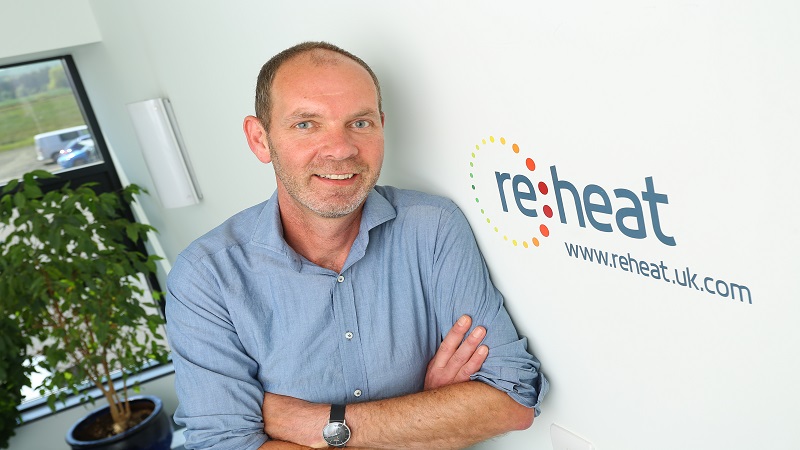
Steve Luker is principal consultant at re:heat, specialists in biomass heat with offices in North East England and Scotland. Before entering consultancy, Steve worked for Scottish Enterprise as a renewables and sustainability consultant. Steve is a recognised expert in bio-energy, advising local and national government, development agencies and the private sector in the UK and overseas on supply chains, energy contracts, tendering and procurement.  For further information, please visit www.reheat.uk.com.


Read part one of Steve’s column here

Greener office spaces boost bottom line and staff productivity, says WorldGBC…

A report from the World Green Building Council (WorldGBC) reveals the impact building owners, designers, developers and employers are having by investing in greener office spaces.

Released under the organisation’s ‘Better Places for People’ campaign, the document pinpoints the global drive behind implementing green and healthy office operation and design, and showcases 15 buildings that are ‘leading the way’. 

As a result of improving noise levels, layout, lighting and indoor air quality at its office in Doncaster, Skanska cut sick days by two-thirds; in turn saving the company £28,000 in staff costs in 2015.

Terri Wills, CEO of the WorldGBC said: “While our earlier work presented the overwhelming evidence between office design and improved health and wellbeing of workers, this report breaks new ground by demonstrating tangible action businesses are taking to improve their workspaces. The results are clear – putting both health and wellbeing, and the environment, at the heart of buildings, is a no brainer for businesses’ employees and the bottom line.”

The report identifies eight key factors in creating healthier and greener offices which can impact on the bottom line:

  1. Indoor air quality and ventilation – a well-ventilated office can double cognitive ability.
  2. Thermal comfort – staff performance can fall six per cent if offices are too hot and four per cent if they too cold.
  3. Daylighting and lighting– a study found workers in offices with windows got 46 minutes more sleep a night than workers without them.
  4. Noise and acoustics – noise distractions led to 66 per cent drop in performance and concentration.
  5. Interior layout and active design – flexible working helps staff to feel more in control of their workload and encourages loyalty.
  6. Biophilia and views – processing time at one call centre improved by sven-12 per cent when staff had a view of nature.
  7. Look and feel – visual appeal is a major factor in workplace satisfaction.
  8. Location and access to amenities – a Dutch cycle to work scheme saved €27m in absenteeism.

Beth Ambrose, director within the Upstream Sustainability Services team at JLL, and chair of the WorldGBC Offices Working Group added: “The business case for healthy buildings is being proven. All over the world, companies, both large and small, are redesigning their offices, changing working practices and trialling new technologies, to improve the wellbeing of their staff, tenants and customers.” 
Access the full document here

Guest Blog, Liz Allen – The Circular Economy: Re-thinking waste…

We have become used to the idea of recycling.  We do it at home, and more businesses are recognising the financial benefits of waste segregation and recycling in the workplace.  But is this enough? What ‘matchmaking’ could you do for your business waste? Could your unwanted waste material be just what someone else needs?

Each time a material is recycled, its quality is generally reduced leading to a higher demand for virgin raw material.  According to Friends of the Earth, humans today extract and use around 50 per cent more natural resources than 30 years ago – that’s about 60 billion tonnes a year.  If we continue in the same way, the amount could be 100 billion tonnes of raw material by 2030. It’s not just the environmental problems associated with resource extraction, there are often social problems such as human rights violations and poor working conditions linked with these industries which we should be taking into account.

There is nothing wrong with recycling, and we should all keep up the good practice while looking out for opportunities to think a bit wider and add an extra loop into a products’ life cycle.  The challenge is to move away from the ‘take-make-dispose’ linear route, and move to a circular model where the life of products and materials are extended before they are repurposed, reused or reprocessed to provide new or different services.

The beauty of a ‘circular approach’ is that it can be tackled at any point of the value chain – anywhere from extraction of raw materials, design and manufacture, through to use and disposal. This affects everyone and is providing the inspiration for all kinds of new business models which appeal to the millennials, who are less materialistically-minded, and environmentalists alike.

All kinds of organisations are piloting new business models to try and rethink waste.  These range from product leasing – where you hand it back for someone else to use, to improving product performance by building in upgradability, through to remanufacturing.  All these approaches try to keep the original material in use for as long as possible to get the best out of it before recovering or regenerating products and materials at the end of their useful life.

Organisations such as WRAP and the Dame Ellen MacArthur Foundation are championing approaches to support innovative business models.  These are popping up all over the place including a company in Holland called Mud Jeans which lets you lease a pair of jeans for a year. After that, you can return them for repair, get a different style or purchase them. St Albans based office furniture specialist, JPA will collect, repair and refresh your office furniture, rather than it going to landfill, while businesses in the FMCG market are looking at ways to redesign products so they can minimise the use of virgin material.

We are great at accumulating ‘stuff’, and apparently up to 80 per cent of the products made are thrown away within the first six months. As a society, we have gotten used to wanting the latest trend and another bit of kit, but this cannot be sustainable? All these products have used other materials to make them and there is not an inexhaustible supply.  Think about the opportunities; we are happy to download music and no longer own CD’s, therefore eliminating (or at least significantly reducing) the production of plastic discs.  So what else could we do?


Liz Allen is an environmental consultant at Hosking Associates Ltd, and has many years’ experience working with diverse businesses to translate environmental issues into practical actions. She helps organisations prioritise risks and opportunities to reduce costs, and manage compliance. Liz is a chartered environmentalist with experience in designing and delivering CSR, sustainability and stakeholder engagement programmes.

Industry Spotlight: FM managers will enter water contracts ‘with confidence’…

In regards to utilities, water is often considered to be the ‘poor relation’ to gas and electricity, as described by the leading specialist water management company, Waterscan. The moderately low cost of water supply and waste water management – coupled with an inflexible marketplace – has led to it being somewhat misunderstood. However, with relatively recent developments and industry analysis, this is expected to change one year from now.

Although the Water Bill was passed over two years ago in May 2014, it is expected that it is set to ‘revolutionise’ the water market landscape in the UK for the foreseeable future. It provides all commercial and other non-household water users the opportunity for the first time to switch suppliers, negotiate contracts in terms of price and service level, and is hoped to result in improved customer service levels. For bigger, multi-site organisations, the move could also potentially reduce administration due to a ‘cohesive, consolidated’ approach to billing.

OFWAT has cited climate change leading to more droughts and floods, increasing environmental standards and a fast growing population as key drivers for this initiative. The focus is all on water efficiency and this is sorely needed as significant risks to water availability have been reported. According to the Water Resources Group, the global demand for fresh water will exceed supply by 40 per cent by the year 2030.

Making less water go further will not only help to make the supply chain more resilient to future demands, but it can also help to reduce bill costs. As the director of Waterscan, Claire Yeates, explains: “The open water market comes into force in April 2017 and that seems a long way off, but negotiations with water suppliers is scheduled to commence in October 2016 – less than 12 months from now. In order for UK businesses to get the best deal, we cannot stress enough how important it is to be prepared – and that preparation needs to start now.”

She continues: “We are encouraging companies to collate 12 months’ good quality water data and to get under the skin of their water consumption. Knowing the detail behind your bills – how much water you use, where and when – will empower facilities managers to enter negotiations with confidence and structure their water contracts in the most profitable and environmentally sustainable way. These are the companies that will see the greatest benefits from the market reform.”

Waterscan suggests that the problem is that much of this information is buried in what could be as many as 27 different water contracts if you’re a multi-site operation, and all water companies have different ‘charging mechanisms’ making accurate price comparisons ‘difficult at best’.

As a company, Waterscan provides a variety of consultancy services including a free and detailed ‘Water Check’ service which helps clients fully understand their current operational water footprint and importantly, to put it into context by benchmarking against industry norms. With minimal input required from clients, this exercise helps Waterscan to take swift action to address any inefficiencies and correct billing errors, which often results in tens of thousands of pounds saved.