Guest Blog Archives - Page 2 of 4 - Facilities Management Forum | Forum Events Ltd
Posts Tagged :

Guest Blog

GUEST BLOG: Working towards sustainability in FM

By Biffa

The clearest definition of sustainability within the FM industry is the focus on long-term environmental goals during decision-making and a notion of total waste segregation, closed loop recycling, and working towards the circular economy.

Currently for England, Wales, and Northern Ireland, there is little legislation requiring businesses to fully segregate and recycle waste, however much of UK businesses must comply with a simple ‘Duty of Care’ when it comes to disposing of business and commercial waste* and as such, waste is moving higher up the agenda in FM tenders.

The CSR and green credentials associated with effective waste management are strong, and many clients are increasingly driven by sustainability targets and are asking more of their FM professionals when it comes to providing the most carbon-efficient and environmentally positive solutions.

The best strategy that FM professionals can adopt is education, ensuring clients and all employees working on site, are fully aware of the recycling solutions available – this is applicable not only to internal recycling options, but also the transfer of waste and maximisation of external bin capacity in order to ensure operations are running as efficiently as possible.

This is where the opportunity to look at using new and innovative waste management solutions, tailored to a client’s individual needs, comes into play.

An informative approach must be taken when assessing the unique needs of a business, and Biffa is able to provide a bespoke on-site service, with dedicated contract managers available to be on hand to influence, enable and guide decisions on waste management for facilities.

These contract managers provide regular facility assessments face-to-face, offering cost cutting solutions and ways to streamline processes.


GUEST BLOG: Facilities Management firms need to streamline efficiencies ahead of Brexit

By Drey Francis, Director at Engage Technology Partners

While the Brexit ‘deal’ remains up in the air and the uncertainty continues for UK businesses, employers in the Facilities Management field are understandably nervous.

As an arena that has undoubtedly been heavily reliant on European talent to fill demand in a skills short environment, the potential to have an increasingly limited pool of staff to tap into is certainly a concern.

In fact, our recent pay data revealed that the Brexit vote has had a direct impact on hourly rates as businesses look to retain staff. According to the statistics, since the vote to leave the Bloc in 2016, hourly pay for skills-short roles has increased, with maintenance positions in particular noting an uptick in money. Handymen and mechanical maintenance professionals reported the greatest increase in the three years since the vote at 13% and 10% respectively, while electricians saw a 5% rise in hourly rates.

Given how sparse some of the talent for these roles is in general, it’s perhaps no wonder that employers are turning to financial incentives to attract staff. However, this isn’t a sustainable approach.

Of course, we still need to wait and see what happens in terms of the agreement on the Freedom of Movement for the UK, but action can be taken now to improve staffing efficiencies in order to better cope with the expected upheaval in Spring 2019.

So where can FM businesses streamline activity to better weather the storm that lies ahead?

Identify the right areas to improve

There’s long been a trend across the industry to limit supplier margins in order to reduce expenditure – a tactic that many will likely turn to as times get tough. However, the true results of this approach aren’t as impactful as you might perhaps be led to believe, and I would argue that this isn’t a sustainable strategy in a talent short market.

Margins have long been on a downward trajectory in recruitment, but when you consider that you ‘get what you pay for’, is this really the right tactic? Yes, identifying where there are inconsistencies in mark-ups will be a beneficial cost-cutting exercise, but only if done while also looking at the wider picture.

In my view, the greatest area of improvement across Facilities Management lies in the often lengthy and quite frankly, inefficient, administrative, recording and resourcing processes. Too often there is a lack of automation and data sharing that is causing significant ‘wastage’ in FM operations.

For example, compliance checks can often be duplicated as information is not stored in one centralised location. Resourcing mangers can also face budget overruns due to inefficient record keeping, with off-PSL agencies used to fill last minute demands when in fact the required staff could be found in other areas of the business. And with many recording tools often being used separate to payroll systems, the entire resourcing management process can become overly complex and the chance of errors occurring is increased.

Don’t forget the candidate experience

Perhaps more importantly, without a truly joined up approach, many candidates and employees are facing an experience that perhaps doesn’t resonate well with their expectations. With budgets pushed lower, the risk for people to be treated as commodities rather than the valued individuals that they are is increased.

And, of course, the limitations of some administrative processes can see staff paid late or not enough due to timesheet or filing errors. The result is a disgruntled workforce that is less engaged with your business and subsequently, more likely to steer clear of your business in the future. A less than ideal situation given that automating admin processes can often be relatively simple to implement.

And herein lies the biggest consideration for FM businesses: how much is it costing you to find out how much it costs? With a disjointed administrative process, it is arguably costing decision makers to find out where there are budget overruns and where savings can be made. All in all, money is being spent to look at how money can be saved, before any concrete action is taken.

But that doesn’t have to be the case – often it is the small efficiencies that can have the greatest impact.

For FM businesses, now really is the time to look at developing a joined-up approach to resource management before the chaos of Brexit truly hits home.

GUEST BLOG: Clamping down on your business’ energy costs in 2018

By Flogas

Energy bills are becoming a bigger focus for businesses around Britain — with the average organisation spending around £4,000. Becoming energy aware (and energy smart) can not only help businesses boost their bottom line, it can also dramatically reduce their carbon footprint – making for a more profitable, greener company all round.

The cost businesses are facing

Cost has changed over time, which has led to this newly found focus on energy supply. For most SMEs, gas and electricity charges now make up a considerable chunk of their monthly outgoings – taking a hefty portion of their profits. The majority of UK businesses are using between 15,000 and 25,000 kWh of power per year, but annual consumption figures for large business and industry can reach in excess of 250,000 kWh.

How will this impact the final bill? The latest data shows that businesses in the UK are spending an average of £3,061 on their annual electricity bills, and an additional £856 a year on gas. Small businesses in particular fare slightly better – but with the average electricity bill for an SME reaching £2,958 (and that’s before putting business mains gas into the equation), it’s still a considerable outlay.

A plan for cost reduction

Many industries will benefit from the right energy supplier and there are plenty ways to create a plan.

  1. Becoming more aware of your energy use

Before you make any core decisions around your energy plan, you must assess how much you actually use and how much it is currently costing you. The average unit prices in the UK are currently 14.36p per kWh for electricity and 4.25p per kWh for gas, with standing charges on top of this. Finding out your business’s annual usage figures – and knowing when your contract is due to come to an end – means you’re well equipped to accurately compare your current supplier’s prices with others on the market.

  1. Look at a range of energy suppliers

Research into other energy suppliers too. Ahead of your contract ending, it’s worth finding out how much switching could save you. And, whether you use a broker, online search or go direct, make sure you don’t limit yourself to the Big Six. Switching to a smaller business energy supplier could mean significantly lower bills, and benefits like better customer service.

  1. Analyse your current contract agreement

There’s plenty of energy suppliers willing to give you a better deal, so make sure you look at your current one before any renewals. For example, an extended fixed-term contract could help protect you against future price rises, giving some valuable peace of mind and making budgeting easier. Or there might be an additional discount on offer if you opt for a Direct Debit payment plan.

  1. Get a smart meter

Talk to your supplier about fitting a smart meter. That way you’ll know exactly how much your business energy supply is costing you day-to-day – and because you only pay for what you use, there’s no need for estimated billing or meter readings. As well as saving on monthly charges, it can also help you wise up to your company energy use and make better decisions on where you might be able to curb your consumption. Energy management software can also help provide useful insight for larger businesses.

  1. Find out where your energy is being used

There’s always room for improvement when it comes to your business’ energy use. It could be as simple as making sure computers are switched off outside of office hours, or putting your lights on a timer, but encouraging employees to find more efficient ways of working is a great place to start. Some companies even introduce incentive schemes to help foster better habits, offering staff tangible rewards for greener behaviour.

  1. Save

Always think of the bigger picture when it comes to energy consumption and try investing in equipment that understands the importance of efficient energy use.  While this approach might come with a heftier price tag in the first instance, any piece of kit that helps save energy on your everyday operations will pay for itself and more in the long run.

*Statistics from BusinessEnergy.com and article brought to you by gas mains supplier, Flogas.

GUEST BLOG: Managing changes to access control panels

As with all technology, access control panels have changed rapidly and frequently over the years. These changes have occurred both to physical access control panels, and digital access control such as smartphones.

Together with 2020 Vision, providers of the latest security solutions such as Cloud CCTV storage, we look at these changes in the past and use this information to predict future changes…

Advancement in technology

Keypads

We’ve come a long way since locks and keys! The way we entered restricted areas has changed over time — and it all started with the famous keypad. Similar to what we now see on ATMs, these were used to access locked areas and would require an individual to type in a specific numerical code to enter. The passcode would usually be around four to six digits long. But was this a viable method to protect a business? At the time, it was a revolutionary idea — but as times progressed, anyone could obtain the code and enter even if they weren’t authorised to do so. This was classed as a non-intelligent reader.

Card Readers

Keypads, however, became outdated technology with the introduction of card readers. Usually, a magnetic strip would be attached to the card which a staff member could then swipe through a narrow slot in order to gain access. However, such cards are now available with a bar code reader, a proximity reader, smart card readers, and biometric readers — tailoring each to specific business requirements.

IP Door Readers

The next stage of advancement came from IP readers, which could be accessed by card or by smartphone signals sent via Bluetooth. Biometrics are now also common in IP readers — unlike card readers and keypads, IP readers can operate independently as they hold an internal memory and if the details you provide do not match what the IP reader has knowledge of, you will not gain access.

The aforementioned changes took place in under 50 years. With such quick development, what’s next for access control panels?

Accessing smartphones

Most smartphones offer a variety of different ‘lock-screens’ as their access control panel. The use of passcodes is still common amongst most devices and are similar to keypads in terms of security. Biometric access, through the use of the fingerprint, is something that is relatively new and has revolutionised the way we get into our phones. However, in 2017, the iPhone X was released which saw tech-mogul company, Apple, introduce facial recognition as the main route to gaining access using a 3D sensor that can recognise the phone owner’s facial features. We suspect that this will be implemented across more smartphone devices in order to compete for the title of being the most accessible and the easiest. However, convenience and simplicity whether facial recognition, fingerprint scanning Bluetooth, and even a short PIN code come at a price they simplify access not only for the authorised user, but also for a potential attacker. So when it comes to implementing an Access Control System always seek the advice of an experienced security integrator.

What does the future hold?

We forecast that the fledgling technology of ‘eyeball recognition’ software will open the way to the next stage of access control panels. As no two people are the same, DNA ensures that access is being granted to the right person. Even in extreme and unlikely circumstances, if someone was to obtain your eyeball, they would still be unable to gain access.

Where imagined technology from movies once seemed out of reach, we are now seeing said technologies become reality. But moviemakers were unaware of how secure they would actually be. In “Diamonds are Forever” in the James Bond franchise, 007 tries to gain access through a ‘copy’ of the required fingerprint. Realistically, if this was to occur, there would be smudges on the fingerprint which would lead to alerts being made and a fail in gaining access.

In “Demolition Man”, we witnessed a group of criminals trying to escape prison with the use of a dead warden’s eye. In reality, this would not get past any sort of IRIS scan, as there is a detection process which determines whether the person is alive or not and a dead person’s pupil would not be responding to any light that is around.

Where do you see access control systems in the future? Will movies this year predict even greater possibilities? And the bigger question is: will they be brought to life? With the evolution of access control happening frequently, and becoming more intelligent, we are sure to see new additions soon.

Sources:

http://securecomminc.com/2014/06/19/the-evolution-of-access-control-systems/

https://en.wikipedia.org/wiki/Keypad

https://en.wikipedia.org/wiki/Card_reader

http://www.tech-faq.com/access-control.html

https://en.wikipedia.org/wiki/IP_reader

https://www.isonas.com/news-education/the-evolution-of-access-control/

https://www.eyelock.com/index.php

http://www.digitus-biometrics.com/blog/biometric-security-in-movies/


GUEST BLOG: The most advanced buildings in the world

Technology is pushing the boundaries across the world, and the construction sector is seeing the same revolution.

Buildings can be planned to a finer detail than ever before, and architects can take their constructions to the next level, with easy access to information such as materials, building use, and climate. Oasys, providers of retaining wall solutions, has joined us to explore some of the best builds from around the world… 

Burj Khalifa in Dubai

The Burj Khalifa (pictured, above), sometimes called the Burj Dubai, stands at a staggering 2,722 feet and holds the crown as the tallest structure in the world. Starting construction in 2004 and finalising the project in 2008, many decisions had to be made to ensure that this neo-futurism structure was able to serve its purpose, acknowledging that it would be a free-standing building and understanding the hot climate it would be situated in.

Desalination plants provide Dubai with fresh water from sea water, which is then pumped to the Burj Khalifa and other skyscrapers through underground networks. When the water hits the Burj, it is distributed to every corner of every floor on every level. However, with 163 floors, this can become a complicated process, which shows us just how special the Burj Khalifa actually is in terms of design.

The structure was created by four architects, who realised that using one pump to send the water to the skyscraper’s heights would be dangerous due to the pressure that could cause the pipes to explode. To counter this problem, they came up with a plan to help the water flow up the building in different stages.

Starting from the basement, the next stage for the water is on the 40th floor reservoir. This then continues to a series of 200,000-gallon tanks until it reaches the top of the building. As the water reaches the top, the water then travels back down under its own weight — it is said that 946,000 litres of water are supplied per day which also helps the building stay cool in the hot climate.

As a desert city, keeping the building cool is a priority. Therefore, another water supply — an ice-chilled water system which is the first of its kind to be used in the Middle East — has also been implemented to enable substantial energy savings.

Taipei 101 in Taiwan

Next on the list is the previous tallest building in the world, the Taipei 101. Platinum certified for Leadership in Energy and Environmental Design (LEED), the building didn’t just focus on beating the then-tallest structure record. Up until 2016, the structure had the fastest elevator on the planet, which could travel from the 5th to 89th floor in 37 seconds!

Taiwan is no stranger to different buildings, housing everything traditional buildings and hyper-modern designs like the Tuntex Sky Tower. But what makes it so spectacular? Starting construction in 1999 and ending in 2004, the Taipei has 101 floors (if the name had not given it away) and is 1,666 ft in height — but the environmental factors that took over its design has changed the way we build for good.

Taiwan is frequently hit by natural disasters, and architects must keep this in mind when designing buildings. When it comes to Taipei 101, the structure can withstand high winds of 134 mph, which is due to the model prioritising resistance through the use of curtain walls, protected glass and high-performance steel. The walls can provide heat and ultraviolet protection by blocking external heat by 50%.

The building is supported by eight mega columns of 10,000 pounds of concrete per inch, along with 28 other steel columns. Within Taipei 101, there are outrigger trusses every eight floors which connect to the columns within the exterior to ensure secure resistance from probable natural disasters in and around Taiwan.

Apple Park, Campus 2: California

Apple, one of the biggest tech companies in the world, has recently moved premises. Worth a staggering $234.7bn, the company, which is now one of the biggest on the planet, was able to invest a further $5bn into a new building and move its tremendous workforce into a circular futuristic structure. The new office-space, which opened in April 2017 midway through construction, is made up of 175 acres — and is even bigger than The Pentagon.

With a roof made entirely of solar panels, it goes without saying that the building is super-energy efficient. The solar panels are capable of generating 17 megawatts of power (75% during peak daytime) and the company has aims to make the complex entirely powered by renewable energy in the future. Another four megawatts are powered through the use of biofuel and natural gas within the complex, using Bloom Energy Servers which are popular within the Californian region, with Google, Yahoo and Wal-Mart using them, too.

Natural air control, heating, and ventilation (HVAC) has been a top focus point for the design team of this building. To achieve this, air is allowed to flow freely between the inside and outside of the building, which can help assist for nine months of the entire year — highlighting the importance of such features in the DNA of design.

It will be interesting to see how technology continues to advance projects that require the balance of design and vital survival features. For example, London is set to have 13 new skyscrapers by 2026 — we know that these will be designed to uphold the ethical requirements for a modern-day structure.

Sources: https://www.airah.org.au/Content_Files/HVACRNation/2010/March2010/HVACRNation2010-03-F01.pdf

http://www.burjkhalifa.ae/en/the-tower/construction.aspx

https://en.wikipedia.org/wiki/Taipei_101

https://en.wikipedia.org/wiki/Apple_Park

GUEST BLOG: Is it true that women are not fairly treated in construction?

Recent research has found that one in five UK construction businesses have no women in senior positions, which is a cause for concern. But, what does the overall situation look like for women in this male-dominated industry?

Here to discuss women in construction and what the future may hold to create a more equal playing field is Niftylifts — a leading supplier of work platforms for a range of UK manufacturing and construction businesses…    

Women in construction: is gender inequality an issue?

When it comes to gender equality, it appears that the construction sector is not faring too well. According to Construction News, 50% of all construction firms claim they have never had a female manager. What is even more striking is that, when asking the women who did work within the industry, 48% claimed they had experienced gender discrimination in the workplace, with the most common example of this (28%) being inappropriate comments or behaviour from male colleagues. These are figures that prove that the industry still needs to enforce more regulations to change attitudes towards women in the industry and encourage equality.

How do construction firms handle equal wages? Nearly half of construction companies (42%) do not monitor equal pay between gender in the business and 68% were not aware of any initiatives to support women transitioning into senior roles. Furthermore, according to Randstad, 79% of men believe they earn the same as their female colleagues in the same position. However, 41% of women disagree — highlighting the need for better pay transparency within the industry to dispel perceptions that men are earning more.

The future of female roles in construction

But what do construction employees think about women’s roles in construction? 99% of roles in construction are filled by men, but 93% of construction workers believe having a female boss would not affect their jobs. In fact, they believe it would have a positive effect by improving the working environment.

All over the country, every sector is feeling the pressure of ensuring gender equality — could this help improve matters for women in construction? According to Randstad, female employees are anticipated to constitute just over 25% of the UK’s construction workforce by 2020. Also, employing more women could help ease the pressure of the sector’s low workforce numbers. With the industry raising concerns that it is experiencing a shortage of skilled workers, 82% of people working in construction agree that there is a serious skills shortage. If demand is expected to require an additional million extra workers by 2020, women could account for a significant portion of that — especially in senior roles, which have previously been bias towards their male colleagues.

By 2020, there will be more women in senior roles within this industry — if research and predictions are to be trusted. In 2005, there were just 6% of women in senior roles within the UK’s construction industry, but by 2015, this rose to 16%. It’s also vital to consider progression, so that we can ensure women get the chance to develop their careers. Back in 2005, 79% of women in the industry were dissatisfied with the progression of their careers. However, in 2015, this number more than halved to just 29%. Some of this progression was even attributed to the fact that almost half of women in the industry (49%) believe their employer to be very supportive of women in construction.

Ranstad reports that there remains a tendency within the industry to exclude women from male conversations or social events, with 46% of females experiencing being sidelined. A further 28% said they had been offered a less important role and 25% reported being passed over for promotion. While there are clearly changes to be made, there are a handful of positives regarding women in construction. Three quarters of female workers say that they would recommend a construction job to a female friend, daughter or niece, and there has been a 60% increase in the average annual salary for women in the construction sector in the past decade.

If progress continues and more focus is on gender equality, there’s no reason why women should not have better paid and more fulfilling roles in construction. But, there’s still a long way to go. Hopefully, by 2020, we can report further positive developments, making roles more attractive to females and providing a solution to the lack of skilled workers in the industry right now.

Sources

https://www.randstad.co.uk/women-in-work/women-in-the-uk-construction-industry-in-2016.pdf

http://rg-group.co.uk/whitepaper-women-and-the-construction-industry/

https://www.constructionnews.co.uk/analysis/cn-briefing/women-in-construction-what-do-the-numbers-say/10029022.article

https://www.constructionnews.co.uk/best-practice/skills/trad-ceo-there-is-a-definite-prejudice-against-women/10028845.article?blocktitle=Women-in-construction&contentID=20127

https://www.constructionnews.co.uk/analysis/editors-comment/tackling-gender-diversity-is-an-education-for-us-all/10028849.article?blocktitle=Expert-opinion&contentID=7125

GUEST BLOG: Maximise your marketing at industry expos

By WhereTheTradeBuys

The challenges of advertising aren’t restricted to design. Many business owners and marketers need to consider where they will place their printed products once they’re complete — put them in the wrong spot and your ROI could plummet!

To help, we’ve explored the multiple locations available to you when you want to optimise your printed ad for maximum exposure. From store window to trade show, read on for advice on maximising your marketing ROI with pull-up banner placement tips.

Event shows or exhibitions

According to Eventbrite, the UK events industry is worth £42.3 billion and 1.3 million business events are held annually. Corporate hospitality accounts for around £1.2 billion, while exhibitions comprise £11 billion and conferences make up the lion’s share at £19.9 billion! Clearly, this industry is big business and you don’t want your company to get left behind if you aren’t active in trade shows and corporate gatherings. But, how do you maximise your exposure when you’re surrounded by so many other brands?

By using print marketing material like pull-up banners, you can hallmark your brand in someone’s mind much better than you could using digital alternatives at an events or trade shows. In fact, according to a study carried out in the US, participants that viewed print media showed a greater emotional response for it and were able to recall its details better than they could for digital ads. If you want to stand out against your competitors at a major recruitment exhibition and create that bond to entice people to come over, why not design an attractive, descriptive pull-up banner and place it next to your stand? If it’s eye-catching enough, it will draw potential partners and employees to your table where you can begin discussing the key details of your business.

At worst, your print banner’s audience will be more likely to recall your brand after leaving the show than they would if there had been a digital ad or no ad at all. This adds longevity to your marketing strategy that will boost your ROI beyond the event itself

To signpost your business location

According to a study published in The Independent last year, employees in the UK are working more overtime than ever before with 60% of those asked stating that they don’t have a good work-life balance. Basically, members of the public and your prospective clients are feeling too busy to waste much time, which could cause an issue when it comes to them locating and visiting your shop.

Are you easy to find? Even if you’re slightly off the high street, tucked away around a sharp corner or sandwiched between two larger stores; you could run the risk of clients giving up on finding you. By placing your pull-up banner in a location that signposts your building, you can direct your customers, as well as advertise your brand to the general public. Use bold fonts and colours to highlight your address and tell people which other shops you’re next to or opposite so they can quickly work out where you are. If you’re thinking about placing these outdoors, make sure you opt for a quality PVC or vinyl banner to make sure your ad can endure the weather for maximum return on your spend.

Reception or shop entrance

Just because your customer is in your building, it doesn’t mean you can’t promote your brand further. The sleek but noticeable dimensions of a pull-up banner will allow it to stand conspicuously in the corner of your foyer or next to your reception desk, while not overpowering the room and making it look cluttered.

Are you still a family-run company? Have you recently added another line of products to your range? Just reached five or ten years in business? Achievements like these matter to people who walk through your door, and the beauty of a pull-up banner is that you have the space to advertise snippets of success stories — unlike with a small leaflet, for example. Studies suggest that it can take as little as a tenth of a second for us to formulate an impression of something, which means that you don’t have long to portray your brand in a positive light when your customers steps into your building. Designing an eye-catching pull-up banner that not only features complementary colours — perhaps matching your reception décor — pleasant fonts and nice imagery, but also highlights interesting information about your company might be another helpful marketing factor to convert sales from new customers and boost brand loyalty among current clients.

According to an article by the Economist, the section immediately inside a shop building is called the ‘decompression’ zone. This is because customers need to momentarily ‘slow down’ to assess their new surroundings. As a result, this is a great place for promotional material. Even if you don’t have a reception area, you can simply place your pull-up banner just inside the entrance for the same powerful marketing affect — another way to boost ROI.

Shop window

A strong and alluring window display can be the difference between a potential customer stepping inside your building and walking or driving by it. According to store design and display consultant, Linda Cahan, in an article published in Entrepreneur: “Each window should tell a story”. Are you making the most of this key piece of promotional space? If you have floor-length windows, simply angle your pull-up banner so it is clearly visible to people and cars coming from all directions. Or, use a platform to give your advert height so it can be easily seen.

What’s more, a store window is a perfect place to advertise discounts and offers — did you know that 80% of consumers describe themselves as ‘promotion sensitive’? Highlighting a special discount on your pull-up banner placed in your store window will give your offer excellent visibility to help bring foot traffic in-store. Also, research shows that discounts can make it less probable that people will then compare your range with your competitors’! Remember to use contrasting colours and large text to highlight your offer on your banner.

Awards shows

Has your company been shortlisted for an award? There are countless ceremonies for every industry taking place across the UK throughout the year — so, how can you hallmark your brand when you’re surrounded by competitors at a special event?

Of course, promotional material at certain awards ceremonies wouldn’t work, as they’re simply a champagne reception and red-carpet affair. However, some are very business-based and can last all day before the awards section takes place in the evening. In which case, use this time to promote your brand on social media and YouTube. A creative, attention-grabbing pull-up banner stamped with your brand logo and key information you want customers or prospective employees to know will work wonders to promote what you do.

Even seeing a print ad like this for a short while will help your brand stay in someone’s mind much better than if you employed digital alternatives — excellent when you’re trying to get one step ahead of the competition. A Canadian study sound that three quarters of people could remember a brand after viewing it via a print media ad. Conversely, only two-fifths were able to recall the company after seeing it on a digital platform. To boost ROI, create a well-structured pull-up banner or two that can act as backdrops to any interviews you hold or videos/photos you take when your staff are at the awards event. Colour, design, content, and imagery are important characteristics — only use complementary colours, clear layouts, insightful text, and high-quality resolutions. Hashtags, contact information and your brand logo are also essentials. Then, share your snaps or videos on social media to spread brand awareness!

There are multiple places you can put a pull-up banner to promote your company. Bear these key tips in mind to maximise your ROI!

Sources:

https://www.uspsoig.gov/sites/default/files/document-library-files/2015/rarc-wp-15-012.pdf

https://www.neurosciencemarketing.com/blog/articles/print-vs-digital.htm

http://www.independent.co.uk/news/business/news/british-employees-working-overtime-no-extra-money-record-high-68-days-additional-pay-a7607596.html

https://www.psychologicalscience.org/observer/how-many-seconds-to-a-first-impression #

https://www.economist.com/node/12792420

https://www.entrepreneur.com/article/223808 https://www.huffingtonpost.com/danny-wong/what-science-says-about-discounts_b_8511224.html

https://www.getelastic.com/coupon-infographic

https://business.tutsplus.com/tutorials/how-to-use-discount-pricing-strategies–cms-28611

https://blog.kissmetrics.com/direct-mail-in-the-digital-age/

Workplace Accidents

GUEST BLOG: Workplace medical emergencies – What should you do?

Would you know what to do in the event of a workplace emergency? If one of your co-workers had an accident or became seriously unwell at work, who would take charge of the situation?

Each year, approximately 30,000 people in the UK have a sudden cardiac arrest (SCA) outside of a hospital environment. Without immediate emergency medical treatment, 90-95% of SCA victims will die.

Knowing what to do if a co-worker suffers a cardiac arrest at work can make the difference between life and death. When someone has a cardiac arrest, every second counts. Every minute that passes without a victim being given effective CPR and defibrillation reduces their chance of survival by 7-10%.

If a defibrillator is used and effective CPR is performed within 3-5 minutes of cardiac arrest, the victim’s chance of survival and recovery increases dramatically, from 6% to 74%.

Just like accidents and injuries, heart attacks and cardiac arrests can strike at any time without any warning. Although not always required by law, having someone in the workplace who has been trained in emergency first aid at work could help to save a life.

Knowing how to perform CPR and having access to a defibrillator in the workplace are life-saving first-aid essentials. Everyone should know what to do if they become a bystander to a cardiac arrest or heart attack. Would you

Sudden Cardiac Arrest or Heart Attack?

It’s important to understand the difference between a sudden cardiac arrest and a heart attack, as each requires very different treatment.

What Is a Heart Attack?

A heart attack occurs when a blockage in an artery prevents blood from reaching the heart. Heart-attack victims can experience a range of different symptoms, including…

  • Discomfort in the chest, back or jaw
  • Shortness of breath
  • Cold sweats
  • Nausea

Symptoms can come on suddenly or gradually over the course of a few days or weeks. Although the heart does not usually stop beating, heart attacks can lead to cardiac arrest if they are left untreated. If the blocked artery isn’t cleared and blood flow isn’t restored, that affected section of heart can begin to die. The longer the blockage remains, the greater the damage caused.

What Do I Do if Someone at Work Suffers a Heart Attack?

Step One

If you suspect someone is having a heart attack…

  • Phone 999 immediately
  • Advise the operator of the victim’s symptoms

Step Two

If the victim is not allergic, give them an aspirin tablet and ask them to chew and swallow it. This will help to thin the blood and allow it to flow more easily.

Step Three

If the victim loses consciousness, begin CPR to help pump blood to vital organs. Stay with them until the paramedics arrive.

What Is a Sudden Cardiac Arrest?

A sudden cardiac arrest is an electrical malfunction of the heart, which stops the heart beating and prevents blood from being pumped around the body. As the name suggests, SCAs can occur very suddenly, often with no warning. The victim will collapse immediately and death can occur within minutes if the correct treatment isn’t used.

Someone who has suffered an SCA will have no pulse, meaning they are clinically dead. The only way to save a person who has had an SCA is to help immediately by using CPR and a defibrillator.

What Is a Defibrillator and Why Do I Need One?

A defibrillator is a device that analyses the victim’s heart rhythm and delivers a shock to them if needed.

What Should I Do If Someone Near Me at Work Suffers a Sudden Cardiac Arrest?

Step One

If someone collapses…

  • First check their responses and see if they are breathing. Can’t detect breathing? This could be a sign that they have suffered an SCA.
  • Phone 999 immediately.
  • The 999 operator will guide you through CPR and tell you where the nearest defibrillator is.

Step Two

After you have called the emergency services and established that the victim is suffering from an SCA, you will need to begin CPR:

  • Place the heel of your hand on the breastbone in the centre of the victim’s chest. Your other hand should be placed on top, with your fingers interlocked.
  • With your shoulders positioned directly above your hands, press down 5-6cm using your bodyweight.
  • Keeping your fingers interlocked and your hands on the victim’s chest, allow their chest to come back to its original position.
  • Repeat this process rate of 100-120 compressions per minute until the paramedics arrive or a defibrillator is located.

If you have been trained in CPR, including rescue-breaths, you should give chest compressions with rescue-breaths. Do not do this unless you have been trained and feel confident using your skills; attempt hands-only CPR instead (as above).

Step Three

If an automated external defibrillator (AED) is available, you must being using it as soon as possible.

How to use an AED:

  • Turn the AED on and follow the voice or visual prompts.
  • The AED will advise you when to stop administering CPR so that it can analyse the victim’s heart rhythm.
  • If a shock is needed, the AED will administer one. An AED can’t perform a shock on someone who is not suffering from an SCA.
  • Continue with CPR between shocks until the paramedics arrive.

Portable Defibrillators for the Workplace

Each week in the UK, 100 people are struck down by sudden cardiac arrests in the workplace. Without CPR and defibrillation, many of these people will die. Does your workplace have an AED in place? Sudden cardiac arrests can strike anytime, anywhere. Invest in a portable AED for your workplace and help prevent more needless deaths from cardiac arrest.

Electric Motors

GUEST BLOG: Your choices to improve electric motor efficiencies

The pressure on businesses to operate more efficiently both in terms of internal processes and environmental commitments is growing. For those working in energy management, a very real concern is the efficiency of their electric motors.

Even with preventative methods in place, electric motor failure is common — and when it happens, it has a huge impact. As machines grind to a halt, productivity ceases and losses and repair costs mount. Given the severity of the situation, it’s very easy to make a panicked decision over whether to rewind and repair or replace your motor.

So what should these motor owners do? With new high-efficiency motors available, do they take the plunge and invest in a whole new motor that promises higher efficiency levels but with significantly greater costs? Or, do they commit to a motor repair or rewind? While the cost is often lower, many are concerned about the potential inefficiencies that an electric motor rewind can bring — yet are these worries grounded in fiction?

This widespread misconception is centred around a small study of smaller motors . It is claimed that carrying out a rewind can drop efficiency by between 1% and 5% each time it is rewound. Considering the associated expense and sheer volume of energy these motors use, this is naturally concerning. However, more recent research has countered these findings.

A different study was carried out by EASA and AEMT in association with Nottingham University and involved 22 new motors from 50 to 300 hp. Overall, the results found that when electric motors were rewound using good practice, there was no significant change in the efficiency of the motors. However, in some instances, efficiency actually increased. This clearly dispels the belief that a rewind is actually detrimental to a motor’s performance.

How to decide whether to rewind, repair or replace

Before you shell out on an expensive electric motor, consider first that it might not be necessary. Of course, in cases of catastrophic failure, this may be your only option. However, it’s very important to fully evaluate your options to make sure that you make the right choice in terms of operation, cost and efficiency. This can be done by considering the following areas, as explained by Houghton International.

The suitability of your electric motor

You’ll know better than anyone how your operational needs have shifted over time, rendering your existing motor unsuitable. Review the scale of the damage alongside the requirements for the motor’s processes and duty cycles. If the motor is no longer suitable or too damaged, your option is to replace the motor.

The stator core and rotor condition

It’s important to check the condition of the stator core and rotor. If significant damage is present, it may be more beneficial to purchase a new motor, as depending on the extent of the damage, repairs can be costly.

When it comes to buying a new motor, thoroughly consider your options. For example, if the lead times for the motor you need are long, you may to decide to repair rather than replace to minimise downtime.

Damage to other mechanical parts

Other parts can become damaged during motor failure, including the shaft, frame, bearing housing and other mechanical parts. Examine the extent of the damage; you may be able to replace the affected parts at a lower cost than replacing the entire motor.

EPAct or Nema Premium motor?

If you have been debating whether to replace your motor for a little while, failure could be the reason you have been looking for. If you are considering making the investment, make sure you fully understand the return you’ll receive from doing so. Consider the energy savings you’ll make alongside the expected life of the motor and its hours of operation. Always consider your overall budget too, to make sure the replacement aligns with your current financial position.

With this in mind, remember than an electric motor rewind will not significantly impact the efficiency of your motor if it is carried out by a qualified service centre. If you are happy with the efficiency your motor delivers, this could be the option for you.

Making the right choices with your needs, budget and timescales in mind can put an end to unnecessary downtime and costs in your business.

Renewable Energy

GUEST BLOG: Wind energy sector growth – UK & beyond

By Hire Torque

Globally, we’re constantly moving towards greener initiatives in order to safeguard valuable resources and protect the planet. In the past, we have been heavily reliant on fossil fuels like coal and gas. Formed over millions of years, our rate of consumption makes these energy sources unsustainable, driving us to develop more environmentally friendly practices.

From wind turbines to wave power, renewables is a buoyant market. However, it’s wind power that has made the most significant impact on how we generate and use energy — and we’re becoming increasingly reliant on it as an energy source.

This is an important trend to track for energy managers.

In 2016, the amount of energy generated through windfarms exceeded the amount created by coal power plants — the first time ever this has happened in the UK. On Christmas Day 2016, more than 40% of all of the energy generated was from renewable sources, with 75% of this figure coming from wind turbines. This was yet another milestone figure, up from 25% in 2015 and just 12% in 2012.

Coal-fuelled electricity has reached its lowest output in some 80 years too, clearly underlining the growth of renewables. So what does the future hold for the wind energy sector in the UK and beyond? Hire Torque, who specialise in Controlled bolting for wind turbines, take a look at the market’s global potential below:

Predictions for the next 5 years

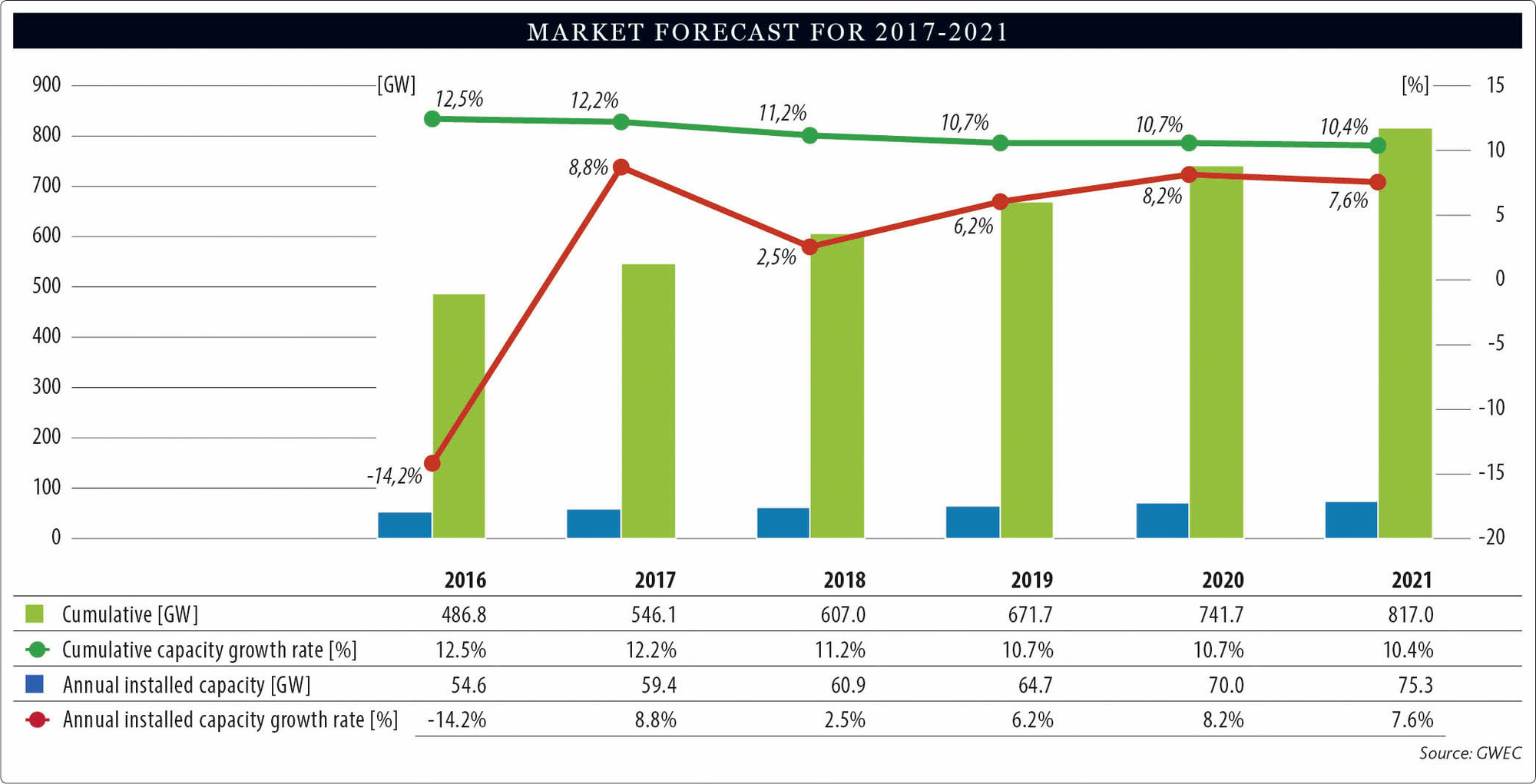
After record-breaking growth in 2014 and 2015, 2016 was a time for the wind energy sector to reconsolidate and consider their next move. In total, the global installed capacity at the end of 2016 was 486,790 MW — an impressive figure by anyone’s standards.

However, growth is expected to pick-up once more in 2017, with predictions expecting the global installed capacity to rise to 546,100 MW. By 2018, this figure will hit 607,000 MW before reaching 817,000 MW by 2021. Although the rate of growth is anticipated to slow, it’s clear that wind power will continue to occupy a large energy share on a global scale.

So how does this performance breakdown on a region-specific basis? Asia, North America and Europe are expected to remain the dominant wind power markets. By 2021, it’s anticipated that Asia will create 357,100 GW of energy from wind turbines. Europe is expected to hit 234,800 GW, while North America is likely to generate 159,100 GW.

Emerging markets are also expected to continue their development. For example, Latin America will grow to 40,200 GW by 2021 — up from 15,300 GW in 2016 — while the Middle East and Africa will more than quadruple their output, growing from 3,900 GW in 2016 to 16,100 GW in 2021.

Future investments

Of course, in order to support the sector’s continued growth, additional investments must be made. In 2016, €43 billion was spent on constructing new wind farms, refinancing, fundraising and project acquisitions — an increase of €8 billion compared to 2015.

It seems the sector is increasing its focus on offshore windfarms as oppose to onshore sites. Investments onshore dropped by 5%, while offshore reached a record-breaking €18.2 billion. Impressively, the UK is leading the way, raising €12.7 billion for new wind energy projects. This dwarfs the country in second place, Germany, with €5.3 billion.

Although this investment is expected to slow in 2017, we have already witnessed a €1.8 billion investment into Europe’s new projects in the first quarter of 2017 alone. While the total investment may be less, it’s clear that wind energy will remain vital to the global movement towards greener, more sustainable energy both now and in the future.

Sources

https://www.theguardian.com/environment/2016/dec/29/christmas-day-2016-renewable-energy-uk-green-electricity

https://www.theguardian.com/business/2017/jan/06/uk-wind-power-coal-green-groups-carbon-taxes

http://www.gwec.net/wp-content/uploads/2017/04/1_Market-Forecast-for-2017-2021.jpg

http://www.gwec.net/global-figures/market-forecast-2012-2016/

http://www.gwec.net/wp-content/uploads/2017/04/2_Cumulative-Market-Forecast-by-Region-2017-2021.jpg