Sustainability Archives - Facilities Management Forum | Forum Events Ltd
Posts Tagged :

Sustainability

Green Energy Legislation – How your business can keep up

Britain’s commitment to its net zero targets has been called into jeopardy in recent weeks. Internal divisions within the Conservative party have seen Rishi Sunak look to weaken some of the nation’s commitments to reaching net zero emissions.

However, evidence shows that customers remain more environmentally conscious than ever. A Deloitte survey found that 35% of UK adults were more likely to trust a business with a transparent, accountable and socially and environmentally responsible supply chain.

So, what can your business do to maintain or grow its sustainability credentials whilst staying in line with green and traditional legislation? The asset finance experts at Anglo Scottish Finance discuss some of the steps UK businesses can take to protect themselves against ever-changing legislation.

Why operating sustainably is more important than ever

In spite of the Conservative party’s stance on the nation’s net zero targets, strong green credentials remain crucial for businesses to appeal to an increasingly eco-conscious public. 29% of UK adults are likely to prioritise a business with a strong public perception, record and reputation around climate change and sustainability over a business without.

It’s not just B2C businesses that have grounds to be concerned. UK companies operating internationally should also be watching the situation closely. The new proposal threatens to undermine UK investment from abroad and weaken our international standing with clients and business partners alike, leaving business leaders furious and investors ‘spooked’.

The EU’s Carbon Border Adjustment Mechanism came into play in October 2023, creating a further divergence between the UK and Europe’s green legislation. EU companies are now responsible for compiling reports on the carbon emissions attached to certain goods, such as steel, aluminium and fertilisers.

So, though the British government may be content with relaxing our net zero commitments, UK businesses operating in Europe cannot be. The onus has been placed upon UK businesses to increase their sustainability credentials or risk being left behind.

Interrogate your operating practices

Companies looking to operate more sustainably are often faced with the initial challenge of identifying exactly where and how the company can become greener. Modern software solutions, however, are making this simpler.

Products such as Microsoft’s Sustainability Manager have given businesses the tools to interrogate their own working practices, acting as a hub for data intelligence from across the organisation. Allowing business owners to precisely calculate the sources of their emissions, this tool enables organisations to record, report and actively reduce their environmental impact.

This level of visibility is a huge benefit to businesses operating in a range of different countries. Even before the Prime Minister’s latest comments, concerns persisted about the UK’s failure to align its sustainability rules with the EU and US.

With the implementation of the EU green tax, international alignment of your business’s green policies is more important than ever. Sustainability Manager allows total visibility over emissions in an international supply chain, allowing your company to strengthen its foothold in the green economy.

Maximise your impact with collaboration – safely

This month, the Competition and Markets Authority (CMA) released new guidance to help businesses better understand how they can collaborate to meet sustainability goals without falling foul of competition law. The Green Agreements Guidance explains how competition law applies to sustainability agreements between firms operating at the same level of the supply chain.

Such examples might include farmers aiming to improve or protect biodiversity by reducing usage of pesticides, or fashion companies agreeing to stop using certain fabrics that contribute to microplastic pollution.

The impact that multiple businesses can have on the environment outranks that of a single business in isolation, so collaboration can be a strong route to improve sustainability practices – but it’s important to do so legally. The CMA has adopted an ‘open-door policy’ regarding business collaboration in the name of sustainability, so be sure to consult them before carrying out a project like this.

Avoid greenwashing – or pay the price

There’s no substitute for real, meaningful change. Given the importance of sustainability to the consumer, some less scrupulous businesses have been caught out by greenwashing – using unproven environmental assertions to sell products or enhance their public perception.

Earlier in 2023, the CMA were given new powers to impose direct civil penalties on companies who have been making misleading environmental claims. Your business could face fines of up to 10% of global turnover for breaches of consumer law in this manner – so any claims related to your business’s sustainability credentials must be thoroughly investigated before going public.

Support the sustainability push with external funding

In many cases, making your business more sustainable is an endeavour which requires significant operational change – and implementing such change can be a costly investment. Businesses should not be afraid of utilising external facilities like green loans or bonds to realise these changes.

Green loans and bonds are subject to an international standard known as the Green Loan Principles, which ensure the transparency of your borrowing and the environmental impact of your changes. This can protect your business against accusations of greenwashing and keep you focused on the task at hand.

Global green finance increased tenfold between 2012 and 2022, indicating just how many businesses are utilising external funding to become more sustainable. Don’t be afraid to explore your options – improving your sustainability credentials could be more achievable than expected.

Charlotte Enright, Head of Renewables at Anglo Scottish, commented: “In light of these changes to the UK’s renewable commitments, it can be difficult for UK businesses to keep informed on their responsibilities. That’s why it’s more important than ever for these companies to be proactive and drive change from within.”

Photo by Micah Hallahan on Unsplash

SEA: ‘Technology agnostic’ approach required to achieve Net Zero buildings

The Sustainable Energy Association (SEA) and Partners’ latest report details the benefits of a technology-agnostic approach to decarbonising buildings.

The SEA and Partners welcome the Government’s drive towards low-carbon heating systems in buildings as part of the Net-Zero agenda. The Chancellor’s Autumn Statement reinforced these commitments through the announcement of the Energy Efficiency Taskforce, delivering overdue reductions in energy demand, and an ambition to reduce energy consumption by 15% by 2030.

The recently released ‘Mission Zero: Independent Review of Net-Zero’, by former Energy Minister, Chris Skidmore MP, also provided a clear assessment of how Net-Zero policy needs to go further and faster.

The SEA states it has long advocated for a ‘fabric-first’, holistic approach to decarbonising buildings. The report brings together expertise from across the industry to explain why incorporating a diverse range of low-carbon technologies into heat and buildings policy is crucial to delivering Net Zero.

It says Government policy should be shaped to deploy the best technologies, in the right circumstances, for the best results—an evidence-led, data-driven, bottom-up and technology-agnostic route to Net Zero. Conversely, it also assesses how the Government’s current approach could be improved, drawing on existing examples from the UK, and from international policies, to drive a more agnostic approach.

The report explores the following primary benefits:

• Accelerated Route to Net-Zero Buildings: How technology agnosticism will target and channel investments into a variety of low-carbon technologies for decarbonising buildings at an accelerated rate, whilst maximising the benefits of healthy and cost-effective buildings.
• Flexible and Smart Building Energy Systems: How a technology-agnostic approach puts more emphasis on the installation of smart and flexible technologies to reduce the costs associated with operating buildings and transitioning to Net Zero.
• Effective Consumer Education and Engagement: How an outcomes-based approach to heat decarbonisation is more appropriate to what, where, and how low-carbon technologies are put forward and installed in buildings, marrying up consumer desires with effective solutions.
• High Quality Skills and Clear Local and National Planning: How a more agnostic approach benefits the transition by deploying tailored solutions using
the most relevant skills at a local level; primarily driven by bottom-up, evidence-based, building-level decision making that target outcomes over a one-size-fits-all approach.
• Stimulating Manufacturing, Supply Chains and Innovation: How this approach will help to stimulate the market and grow capacity for transitioning to Net Zero. As the investment landscape takes on a more concrete form, with clear pathways for industry to supply demand, manufacturing capabilities, product investment, and supply chain diversity and resilience will grow, benefitting the UK’s low-carbon economy.

The SEA’s ask is that if the Government is truly driven to capitalise on the best outcomes from the transition to Net Zero and deliver solutions for the country that match these desires, then policies covering the built environment need to be more data driven, evidence led, outcomes focused and technology agnostic.

Bim Afolami, MP, said: “The Sustainable Energy Association’s latest report emphasises the need for flexible, low carbon and smart technologies to be at the centre of home heat solutions. Our built environment is historically complex and diverse, so a range of interventions are needed across the domestic heat market. This report sets out the need for a variety of data-driven, market-led and bottom-up approaches to decarbonise construction, diversify supply, promote cost-efficiency and support delivery. The contributors to this report have done the legwork to demonstrate how this can be achieved in line with our mission to reach Net Zero by 2050.“

Jade Lewis, Chief Executive of the SEA, said: “The SEA is steadfast in its commitments to deliver living and working space fit for future generations. To help us realise this vision, government policy for heat and buildings needs to be long term and joined-up, taking a fabric-first, holistic and technology-agnostic approach. This report lays the foundations as to why these policies should take into consideration a wider range of technologies, so that we can provide homes and buildings with the best solutions for Net Zero.”

“At ABC, since 2019, we’ve been all about energy systems integration, whether that be in new build, retrofit, social housing to business parks. What is clear is that there is no one size fits all. To achieve better outcomes, we have learnt that it is vital there is an evidence-based approach to policy, regulation, and funding, and this report highlights this need too.”

Dan Cook, Chief Executive Officer, Active Building Centre, said: “The REA is delighted to support this report and a technology-agnostic approach to heat and buildings policy. The adoption of the most appropriate and effective low-carbon technologies will be accelerated by a technology-agnostic strategy, which will also produce the best results for building occupants without stifling innovation.”

Dr Nina Skorupska CBE FEI, Chief Executive Officer, Association for Renewable Energy and Clean Technologies, said: “With 2050 fast approaching, the UK must use every tool and technology in its armoury to bring down our emissions. There is no ‘one-size-fits-all’ and a technologically agnostic approach will enable a wider, more suitably skilled, and better-qualified workforce to deliver the solutions we urgently need for decarbonisation.”

Key challenges for Net Zero offices laid out in BCO report

Delivering Net Zero Carbon in the Workplace, produced by University College London Consultants (UCLC) for the British Council for Offices (BCO), identifies the barriers that businesses are facing as they strive to drastically reduce their workplace carbon footprint.

The report, informed by over 100 office occupiers and building professionals, outlines the measures that can be taken to overcome these barriers – at low or zero cost. These include:

  • Greener and longer leases, with office occupiers having more say over refurbishments
  • Greater collaboration and data sharing between building owners and occupiers
  • Submetering and the use of sensors to measure exactly where energy is used
  • Use of pre-fabricated, re-used and recycled materials and furniture

Clearly, achieving net zero carbon emissions is a major component of Environmental, Social, and Governance (ESG) strategies in the commercial real estate sector, driven by a growing expectation from businesses, their customers and ultimately the public, to respond to the effects of climate change. The current energy crisis that began in 2022 is also focusing minds and investment on improving energy efficiency.

Yet improving the energy performance of offices is challenging, particularly as 50% of the office building stock in the UK is tenanted – meaning there is little consistency even within single buildings as to how workspaces are designed and used. Only 12% of building professionals and office occupiers consulted for the BCO’s report believe that operational carbon targets are currently being achieved by those involved in designing and developing office buildings.

The reports says that for the office sector to move from ambition to tangible action, there is an urgent need for robust benchmarks and verifiable data, as well as government requirements and incentives to support businesses’ ESG objectives and facilitate the transition to net zero.

The relationship between building owner and occupier is an essential factor in energy management. Tailoring lease agreements to promote lower energy use and carbon emissions, known as ‘green leases’, would be a potential solution to reaching net zero targets collaboratively.

Currently, it is difficult for occupiers to measure their carbon emissions accurately because targets for energy use intensity do not differentiate between different types of office. In addition, dysfunctional metering strategies do not allow for a breakdown of energy use between communal and occupier areas.

Energy wasted through under-utilisation of office space since the COVID-19 pandemic, as shown in the BCO’s recent The Future of Office Densities report, remains a concern that can be alleviated through using smart sensors and responding to demand.

Retrofit is an increasingly popular approach among developers but the works involved make it highly disruptive to any existing occupiers of a building. Careful phasing and use of prefabricated components can mitigate disruption on site – and contribute to a circular economy if designed for disassembly in the future.

The report says it is vital to assess carbon emissions associated with the complete lifecycle of a building in order to strike the right balance between operational carbon[1] and embodied carbon[2] when refurbishing buildings. A clearly defined division of funding responsibility for net zero improvements is also needed to avoid any doubt, or dispute, between building owners and occupiers.

A key issue to address is ‘Category A’ interior fit-outs (which comprise lighting and basic finishes such as flooring) being installed by the building owner and then discarded by the incoming occupier, in favour of their own bespoke fit-out.

The BCO says most office spaces would benefit from ‘Cat A+’ (plug and play) fitouts for shorter and more flexible tenancies in light of the market trends seen since the COVID19 pandemic. Prioritising locally-sourced materials with lower embodied carbon and using recycled, reused and further recyclable furniture can also support more environmentally friendly fit-outs.

Richard Kauntze, Chief Executive of the BCO, said: “The office sector has a significant contribution to make to the UK’s net zero transition. There is a clear desire from those involved in creating and occupying workspace to hit ambitious targets, but we need to see evidence of innovation and improvement which demonstrate meaningful progress.”

Dr Esfandiar Burman, Associate Professor at UCL’s faculty of the Built Environment and author of the report, said: “This report shows that greater energy and carbon accountability and more effective ESG frameworks can be achieved through greater collaboration between building owners and occupiers, along with data sharing and greater transparency.”

Food waste impacting Net Zero ambitions

Unprecedented pressure on supply chains has led to food buyers in the UK’s biggest organisations reporting a 60% increase in food waste over the last six months.

This surge casts doubt on the food industry’s ability to meet the UN’s Sustainable Development Goal to reduce food waste by 50% by 2030, and hampers progress to net zero.

This is according to a new study commissioned by Sodexo UK & Ireland evaluating how large organisations are navigating the current supply chain crisis and its impact on food waste and carbon emissions. It found 83% of respondents say they have created a more resilient supply chain after the pandemic; however, food waste is increasing for a majority of companies.

Sodexo’s research shows that to increase their resilience, UK food supply chain heads are increasingly diversifying their supplier base by working with smaller suppliers, with over a third (38%) doing so. 35% are also looking to source more food domestically.

SMEs form the backbone of this approach with 81% saying the current supply chain crisis has emphasised the need to source more from SMEs. Some suppliers are eager to collaborate further, with 38% agreeing that the sharing of best practice with SME partners in the supply chain to improve efficiencies will best help address the UK’s supply chain challenges.

Commenting on the findings Aoife Wycherley, Head of Supply Chain & Food Procurement at Sodexo UK & Ireleand, said: “Diversifying the food supply chain is essential for building resilience. SMEs can enable greater agility because they’re more flexible, innovative and, tend to drive domestic food sourcing which, in turn, can reduce carbon by cutting down on air and freight usage. This makes having SMEs in the supply chain essential for those that need to maintain supply and meet climate targets.”

Carbon data reporting is, however, a huge burden for small businesses, and we need greater industry collaboration from large organisations to support them with this challenge in order to achieve net zero in the supply chain.

The findings come as Sodexo continues its work with SMEs. These account for three-quarters of its supply chain and for 44% of its spend, enhancing its resilience to continue delivering meals to customers, despite the external market shocks the industry is facing.

Reducing food waste is a critical part of minimising carbon emissions in the supply chain. Despite this, over one third (35%) of respondents admit to deprioritising food waste due to the ongoing challenges in the supply chain over the past year. A similar proportion (34%), however, do support the introduction of mandatory food waste reporting which is proposed in the Government’s recently published food strategy.

Claire Atkins-Morris, Director of Corporate Responsibility at Sodexo UK & Ireland, said: We welcome the Government’s decision to consult on mandatory food waste reporting, something which we’ve been calling for in our Appetite for Action campaign. The first step towards cutting food waste is tracking and monitoring. More broadly, we urge government to take a holistic approach to all areas which will determine the success of net zero policy making, including food waste, carbon reduction and supply chain resilience. The strategy must be broader than focusing on renewable energy and the introduction of electric vehicles.”

Sodexo, which has pledged to cut its own food waste by 50% by 2025 and achieve net zero by 2045 – found that achieving net zero emissions has become the most important priority for 80% of respondents. Sodexo reduced its greenhouse gas emissions by 38.5% in FY21, (against a 2017 baseline measurement of 1.16million tonnes of carbon) across Scopes 1, 2 and 3 which includes emissions from the supply chain. The research also found two-fifths (40%) of food supply chain heads are calling on businesses to adopt net zero policies to future proof a supply chain adhering to science.

Sodexo partnered with WRAP last year in support of the first ever Food Waste Action Week to tackle food waste and help save the planet. Sodexo is also a signatory of The Courtauld Commitment 2030, a voluntary agreement that enables collaborative action across the entire UK food chain to deliver farm-to-fork reductions in food waste.

Keith James, Head of Policy and Insights, WRAP, added: “Through Courtauld 2030, WRAP has partnered with Sodexo to tackle climate change, food waste and water stewardship. Sodexo’s findings relating to a rise in self-reported food waste are worrying, but not unexpected given the pressures put on supply chains in recent years. WRAP will publish data later this year to show where the UK is in terms of tackling food waste, GHG emissions connected with our food and drink, and water stewardship. Every business can make a difference by instigating the Target-Measure-Act approach, but not all have the flexibility to adopt strategies quickly with competing pressures. That is why WRAP published new Scope 3 protocols for measuring GHG emissions linked to the food we make, sell and eat.”

Water-saving will help on energy costs – get additional support from our experienced Advanced Services team

Reducing resource use and improving efficiency are key steps organisations will need to take to retain credibility on green steps they’re taking on their Scope 1, 2 and 3 emissions, to help lower impacts on the environment. 

Although water is under Scope 3 on your emissions, it shouldn’t be looked at last as it can help lower energy costs too. Getting more data on where water is used is an important first step.

Green Apple Environment Award winner Water Plus installed more than 400 data loggers on water meters in the space of six months in 2021 – providing further information on how it’s used across buildings.

Mark Taylor, Advanced Services Operations Manager in England for Water Plus, said: “With energy costs in the news, there are some areas where there are low-cost opportunities and options for organisations, particularly if the number of people at sites is fluctuating through a year. This is why tracking what water is used throughout a year is important.

“As there are carbon emissions linked to the water you get through taps, and the wastewater taken away and treated, it also shows that by just boiling the water you need in work kitchen kettles – to reducing water waste from any leaks, including dripping taps, running toilets from cisterns – and elsewhere at your site – soon adds up to lowering running costs, creating less carbon overall and using less energy too.”

Here’s where water-saving can make an impact:

  • In January 2022, a site had a 12 cubic metre an hour water leak but was not sure where on their pipes. They contacted Water Plus Advanced Services, who located the source of the issue and carried out the repair work. The leak, which data loggers on the water meter and the online portal also tracked, would have cost £22,000 in a month.

Work with organisations by Water Plus is also being recognised this year. The water retailer is shortlisted for Water Efficiency Project of the Year in the Water Industry Awards 2022 and was named a Finalist in the Environment Award at the Better Society Awards 2022.

To contact our team, please email hello@water-plus.co.uk – and include “FM Briefing” in the email subject heading. More tips to #BeWiseOnWater on the FM Forum website here – and at: www.water-plus.co.uk/sustainability .

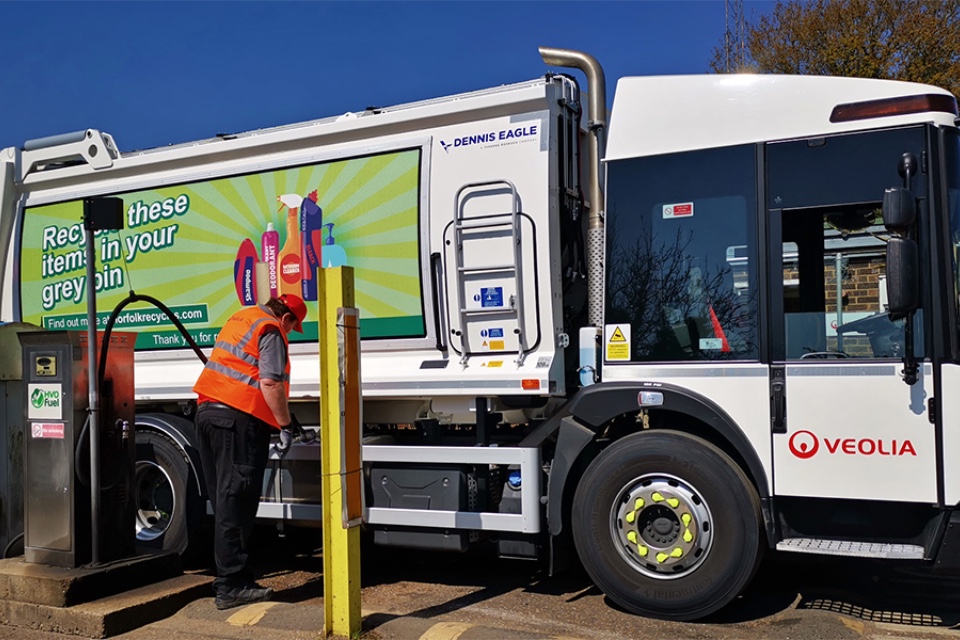
Veolia rolls out first renewable-fuelled fleet using hydrotreated vegetable oil

Broadland District Council’s latest contract for all waste collection services including residual, recycling and food waste and for street cleaning with Veolia will see the FM specialist utilise a renewably-fuelled fleet for the first time.

The 10 year contract that started in April 2022 has an option for an extension of up to a further 10 years.

Reducing energy consumption and reaching carbon neutrality is essential for combating climate change and the new contract includes a commitment to reduce operational emissions and to develop low carbon solutions. This supports Broadland District Council’s priority to protect the environment and for continuous environmental improvement.

Every vehicle in the fleet is fully powered by Hydrotreated Vegetable Oil (HVO), a bio-based liquid fuel made from vegetable oils and animal fats. HVO is a low carbon, low emission, fossil-free and sustainable alternative to conventional fossil diesel which eliminates up to 90% of net CO2 and reduces nitrogen oxide (NOX), particulate matter (PM) and carbon monoxide (CO) emissions.

HVO fuel is fully interchangeable with conventional diesel and can be used pure or blended with fossil diesel if required. The fleet in the Broadland district will be solely powered by HVO in a first for Veolia in the UK.

Councillor Judy Leggett, portfolio holder for Environmental Excellence, said: “We’re very pleased to be continuing our very successful working relationship with Veolia through the award of this major new contract. The contract brings together an excellent service for residents with innovative new approaches which will help to make our waste and recycling services more effective and even more environmentally friendly. This new contract will help drive us towards our aim of being carbon neutral well ahead of the Government’s 2050 target.”

Pascal Hauret, Managing Director Municipal, Veolia UK said: “We’re delighted to launch our first fully HVO powered fleet in Broadland. HVO significantly reduces CO2 emissions so this is a hugely positive step in our shared commitment to net zero. Importantly, whilst the availability of HVO is still limited in the UK, Veolia has secured a guaranteed supply for the entire contract term.”

The new contract also offers residents an enhanced service with the introduction of weekly kerbside collections of small electrical and electronic equipment (WEEE) and textile collections.

The Council will continue to roll out food waste collections and will now be able to achieve its goal of food waste collections to all Broadland residents in 2023.

Three quarters of UK businesses unaware of Plastic Packaging Tax

Research conducted by YouGov, on behalf of Veolia, explored the views of British-based senior decision makers across retail and manufacturing businesses on the incoming Plastic Packaging Tax.

The tax places a £200 per tonne levy on producers or importers of plastic packaging if they do not include 30% recycled content and will come into force from 1 April 2022.

The survey found that only a fifth (22%) of the manufacturing and retail businesses asked had already opted for recycled content in their packaging. To reach the UK’s Net Zero goals, far more businesses must reduce their reliance on virgin materials. The majority of British retail and manufacturing businesses also support an escalator in percentage of recycled content threshold (63%) and cost charge (50%) as an incentive to use recycled content.

The British retail and manufacturing businesses who had made changes to their plastic packaging reported:

  • Two thirds (66%) have reduced the amount of unnecessary or avoidable plastic packaging
  • Over half (58%) now use recycled content
  • 54% have changed the packaging design to make it more recyclable
  • 39% have chosen alternative materials to plastic for their packaging

“The UK’s Plastic Packaging Tax is the right way to start getting businesses to push sustainability up the agenda, but it needs to go further. A tax escalator would make choosing to incorporate recycled content in packaging both economically and environmentally preferable to using virgin materials,” said Gavin Graveson, Veolia’s Northern Europe Zone Senior EVP. “Not only could the UK save up to 2.89 million tonnes of carbon emissions every year if all plastic packaging included 30% recycled content, it would also incentivise investment in domestic infrastructure which could make the UK a world leader in plastics recycling.”

Clarity, consistency, and confidence needed to deliver Net Zero

2021 was an eventful year for anyone working in the sustainable energy sector, with the Government publishing a whole host of policies and strategies, including the long-awaited Heat and Buildings Strategy. There is no question about how much the Strategy was needed; 17% of carbon emissions from heating buildings in 2019 came from homes. That’s comparable to the total emissions from all petrol and diesel cars. Long-term vision is what we have all been waiting for in the hope that it will result in actions being taken to reverse the tide. But does the sector have what it needs to deliver net zero?

Now that we have had the strategy for some time, Jade Lewis (pictured, right), Chief Executive at the Sustainable Energy Association (SEA), has taken the chance to explore what questions and policy gaps remain for our industry, and here is what we found…

CLARITY

Clarity is important. We need roadmaps, dates, and certainty from government to provide a clear direction of travel, set out over the long term. That’s how businesses justify investments, prioritise certain product lines and decommission others. To put this into perspective, the Heat and Building Strategy was originally due in August 2020, and yet the lack of clarity caused by its delay made it all too easy for our industry to lose focus and hold off on investing in much needed capacity building and innovation.

Due to lack of clarity, the questions around how we will engage the ‘able-to-pay’ sector, which makes up 60% of our consumer market, also remain unanswered. In essence, we need direction on how we can work together to transition those who are able-to-pay to willing-to-pay. But this is by no means a new question. It’s one which has challenged the industry for years, and one the SEA tackled again in our 2020 report, ‘Addressing the Able to Pay Sector’.  Yet, we are still waiting for intervention from the Government.

We have seen numerous policies published over the decade, some of which are now well established, like the Energy Company Obligation (ECO), whereas others have fallen prey to cutbacks. It’s so crucial that we get timings right. Without clarity and stability, the industry can become entrenched with rumours about what policies could be ‘cancelled’ or what may or may not be ‘delayed’. As an organisation, the SEA is in a good position to filter out rumours we know to be incorrect due to our policy insight. However, such uncertainty can stifle much-needed investments from more isolated organisations and SMEs.

CONSISTENCY 

Over past years we have seen many policies and schemes launched and then cut short before the industry has had an opportunity to mobilise to deliver. We have seen various funding schemes aimed at supporting different technologies such as PV, renewable heating, biomass, etc., and now heat pumps are very much on the Government agenda. Investigations, set out in our report ‘Designing an Effective Home Upgrade Grant Scheme’, found that short-term funding terminated at the last minute distorts the market, with ‘stop-start’ funding decimating the number of installers in the market. A long-term guarantee instead instils confidence in industry to enable upskilling, product development, service offering, and innovation in the market. To frame this in our current time, we can look at the Boiler Upgrade Scheme due to begin in April this year. But how do we move from 30,000 heat pump installations a year to 600,000 a year from 2028 when there is a general reluctance to fully commit? This hesitation is easy to understand. Previous policies such as the Green Deal, and more recently the Green Homes Grant, have been withdrawn after companies had spent valuable time and resources to prepare to play their part in the delivery.

CONFIDENCE

Finally, and most importantly, we need confidence. Because of the lack of clarity and consistency, the industry lacks the confidence it needs to justify investment in the necessary capacity, resources, and training. Research carried out by the University of Sussex into why heat pumps are so widely adopted in places like Finland found that it is the long-term policy environment that supports business investments and individuals to choose a career in the low carbon heating industry. We need existing installers to retrain and newcomers to commit to a path – this isn’t just about business investment, but time and personal investment. A show of faith and steadfast direction will go a long way to reassure installers, who are the backbone of our industry, that they have made the right decision and have an important role to play in our transition to net zero. We know that many installers have informed local authorities that they have no appetite for future government schemes, so providing reassurance will be a challenge. It has also been suggested that the rollout of short-term policies into an immature market has increased installation costs for eligible measures.

CONCLUSION

Whilst we welcome the Heat and Buildings Strategy, we can appreciate the magnitude of the challenge before us. We are seeing the beginnings of a momentum that will change the way we do things in the energy and the construction sectors for decades to come. Provided we as an industry seek to work collaboratively with the Government to address the questions surrounding clarity, consistency, and confidence, we believe that we will be on the right path towards a just and efficient transition to Net-Zero.

Half of businesses agree that ESG efforts are about the bottom line

Less than a half of consumers (49%) trust brands that say they’re sustainably and ethically driven in their marketing and branding, or that they are aiming to achieve net zero by a certain date (47%).

Similarly, only 15% of business decision makers in business to consumer businesses are completely confident that all the materials their organisations use are responsibly sourced.

What’s more concerning is the motivation behind the distrust. According to research released by NAVEX Global only a quarter (25%) of consumers believe businesses are primarily motivated to undertake environmental, social and governance (ESG) initiatives to make a positive difference to the world and over half (55%) of businesses agree it’s more about that bottom line.

The research conducted with Sapio Research of 500 business decision makers and 2,000 consumers in the UK launches following COP26, which emphasised the global urgency to tackle climate change for the future of the planet.

While talk of ESG issues might be dominating the headlines, it’s widely believed more can be done. 74% of consumers and 85% of consumer businesses agree that most businesses could do significantly more on their efforts to be ethical and sustainable.

However, only a quarter (25%) of consumers think making a positive difference in the world is one of businesses’ top two motivations for undertaking ESG efforts. Equally, just 27% of businesses say ESG investment is one of their top three priorities for the next financial year, despite the fact that over half (55%) of consumers think it should a top three priority and a further 17% that it should be the number one focus.

However, when it comes to who they believe is responsible for enacting change, businesses and their own organisations come out top. Half of businesses (50%) think that their own organisations are responsible for ensuring ethical and sustainable practices are upheld within their organisation and throughout their supply chain. Consumers agree; 38% also felt this was the business’ responsibility. At the same time, 32% feel the government should be taking responsibility for this too.

While there may be a contrast in perceptions around how much a business is or should be doing towards sustainable and ethical issues, there could be a significant impact on business, nonetheless. Almost three in five (59%) consumers say they would stop doing business with a company if there were negative news stories about their ethical and sustainable practices, and over half (54%) believe that only businesses that uphold standards in these areas will continue to be successful in the future. Furthermore, 37% of consumers overall and 57% of those aged 18-25 say they’ve stopped buying from a brand because they did not consider it sustainable or ethical.

Consumers are making active decisions on where they purchase based on sustainability and ethics, much to the surprise of businesses decision makers amongst whom only 18% think that consumers consider whether something is ethically or responsibly sourced when making a purchase. Despite this, 60% of B2B businesses say they agree their customers will leave them if they fail to demonstrate ethical and sustainable practices in the future, but less than half (45%) of consumer businesses agree with this. 

The current perceptions on business and the reality that consumers are willing to leave a brand because of ethical and sustainable practice is a concern. At the core, confidence and trust are lacking. A third (34%) of consumers say they don’t think any industry is tackling climate change well. Similarly, only 17% of all businesses surveyed were completely confident that the businesses they partner with or outsource to operate ethically and sustainably, despite 45% saying they personally research companies they work with. Not only do consumers lack trust in the brands they buy from, but businesses themselves do, too.