Health & Safety Archives - Page 4 of 6 - Facilities Management Forum | Forum Events Ltd
Posts Tagged :

Health & Safety

How to get your employees back to work safely and smoothly

iHASCO, a market-leading provider of Health & Safety, HR and Compliance eLearning, are currently adding a number of online programmes to their course library to help organisations get their employees back into the workplace as safely and smoothly as possible.

“Covid-19 has resulted in a hugely challenging time for businesses for a number of reasons, and as steps are taken to exit lockdown the return to work process will provide employers with even further challenges” says Alex Morris, Director at iHASCO. “iHASCO have created a returning to work essentials training bundle which will assist employers with helping their staff return to work with confidence and reassurance that their health and safety is taken seriously, which will play a major role in resuming safe operations.”

Among the titles to be released is ​Returning to Work after COVID-19 Training​, a course that focuses on easing an employee’s transition back to work in light of Coronavirus. It will cover important aspects of the return to work process, such as risk assessments, team communication and handling anxiety in connection to Covid-19. It also provides an insight as to what an employee can expect on their first few days and weeks back at work to help them adjust.

A ​Resilience Training​ course will also be available, which will provide employees with practical techniques to build resilience and deal with challenging situations. This is a crucial skill in times of adversity and empowering the employee to regain focus, control, and perspective will help with a smooth transition back to the workplace.

These two courses will come as part of iHASCO’s ​Returning to Work Essentials Bundle​, along with other important titles such as DSE Training, Fire Awareness Training, Infection Prevention & Control and Mental Health Awareness Training.

Employers are also being encouraged to take advantage of iHASCO’s ​free Risk Assessment Tool​ to conduct a Coronavirus Risk Assessment – which will be crucial upon planning a return to the workplace.

Due to the uncertainty of the weeks and months ahead, a clear and careful plan to reopen a workplace is required to ensure the safety of employees and any visitors to its site. This, together with online training for employees, can provide a solid foundation to get a business focussed and navigate the challenges it faces.

Organisations that feel these new courses could benefit them should ​register their interest​ through the iHASCO website.

Go-4-Zero accidents at work: Tips & tools to manage safety risks

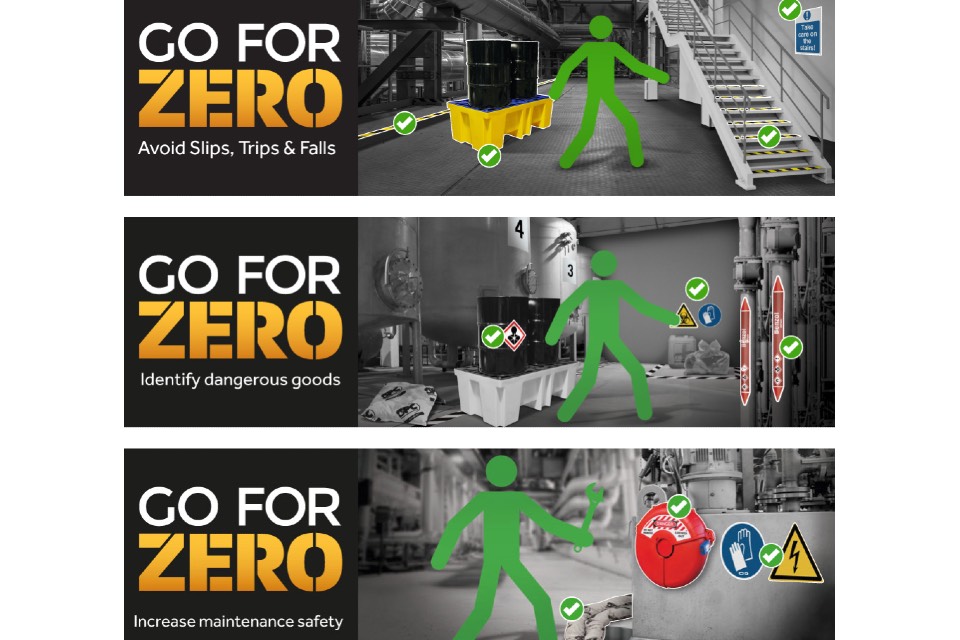
According to the latest numbers from EUROSTAT, 3.2 million non-fatal accidents happened in the EU in 2015, and 3876 fatal accidents, resulting in 42 million working days lost. Increasing workplace safety is not only a humane, but also an economically sound strategy to protect company profits. Brady proposes a number of safety identification solutions to help reduce workplace risks for some of the most frequently occurring accident categories.

  • Avoid slips, trips and falls
  • Identify dangerous goods
  • Increase maintenance safety

Check out Brady’s “Go for Zero” solutions!

BRADY UK

Banbury, Oxon OX16 3JU

Tel: +44 (0) 1295 228 288

csuk@bradycorp.com

Solutions to keep your people & workplace safe

At Brady, we are closely monitoring the impact of COVID-19. We aim to continue to respond to your identification and safety needs for your people, products and premises.

  • Safety signs

Identify and warn visitors and staff of potential hazards with our hazard warning signs.

  • Area Marking

Ideal for controlling and directing foot traffic.

  • Spill Control

A range of emergency response kits to handle any type of spill.

  • Print your own identification solution

The ability to print your labels on-site enables you to quickly respond to any identification need and can eliminate all waiting on label deliveries.

Discover our coronavirus related identification and safety solutions >>

BRADY UK

Banbury, Oxon OX16 3JU

Tel: +44 (0) 1295 228 288

csuk@bradycorp.com

www.brady.co.uk

New research puts safety eyeware in to focus

Comfort is the overriding requirement for safety eyewear, according to research among over 500 UK companies.

The Specsavers study looked at which features and benefits are the priorities when choosing prescription safety eyewear for employees, with the majority (57%) selecting comfort. This was followed by the opportunity for employees to actually try on the glasses for comfort and fit, selected by 40%.

In a perhaps more surprising aspect of procurement requirements, aesthetics also featured heavily, with 30% of employers looking for availability of designs for both men and women, while 27% were concerned with style. A quarter (25%) of employers were interested in the brand of safety eyewear, which may be about fashion but may also be about reputation for safety and robustness.

Cost was a consideration for nearly a third of employers, with 29% stating this as a feature they consider when selecting safety eyewear.

Jim Lythgow, director of strategic alliances at Specsavers Corporate Eyecare, said: “Of course protection is the major concern for safety eyewear, but it is also very important that safety glasses look and feel good. If they are comfortable, fit well and look stylish, then employees are far more likely to actually wear their eye protection.”

The ability to try on safety eyewear was the second most popular requirement, linked to the main criteria of comfort. It is possible to procure safety eyewear from a variety of sources, including online and paper catalogues. There is, however, no substitute for evaluating different frames in person. While the choice of safety glasses will be dictated to some extent by the setting and task, there is still often a wide range of options available to the employee, which can only be truly assessed in person. Professional one-to-one fitting advice is a vital part of the process.

Lythgow concluded: “It is very positive that employers are aware of the many additional features and benefits of eye protection and that they understand the importance of comfort, fit, and even aesthetics. It is crucial that employees are happy with their safety eyewear, as this is half the battle in it being worn consistently.”

Key findings from the Specsavers study:-

In addition to protection, which other features and benefits do you look for when choosing prescription safety eyewear for your company’s employees?

  • Comfort 57%
  • Ability to try on for comfort and fit 40%
  • Designs for men and women 30%
  • Low price 29%
  • Style 27%
  • Brand 25%

Image by roegger from Pixabay

Burning desire – Why fire training is the hot topic in health and safety

By Alex Wilkins at iHASCO

Look anywhere you want in the media and I guarantee you will find news and warnings about fire risks. Yet despite its catastrophic potential, the relatively day-to-day nature of fire damage is rarely appreciated. In truth, fire is a constant and very real hazard to UK organisations.

Home Office figures show that in the reporting period 2018/19, the UK’s fire and rescue services attended 15,005 ‘primary fires’ in non-dwelling buildings. That’s more than 280 per week; and those incidents caused 17 deaths, plus a further 1,061 non-fatal casualties.

Fire can also be disastrous in terms of operations, productivity and financial loss. Worldwide, fire and explosions cause the largest losses for businesses. Around 70% of businesses fail within three years of a major fire.

Thus, when it comes to fire, prevention is clearly much better than cure. But it’s impossible to predict when, where and why a fire may break out. Therefore, a culture of fire prevention must prevail throughout the organisation, from top to bottom.

Organisations in the UK simply have to take fire seriously. In some respects, their attention is mandated by law. Employers are legally required to train each of their employees in fire prevention under the Fire Safety Order 2005 and Health and Safety at Work Act 1974.

But how can managers be sure their entire workforce is taking fire safety seriously?

What are the dangers?

Workplace fires can arise from a range of causes. These include faulty equipment (such as electrical equipment like kettles and ovens), clutter (particularly combustible materials like paper, wood, furniture etc.), poor standards of cleaning (for example when grease or oil is allowed to build up on equipment, or dirt and dust cause machines to overheat), human error (misuse of equipment, failure to implement safety practices or report malfunctioning machinery etc.) and arson.

The good news is that fire is frequently preventable. It is notable that according to the Home Office figures mentioned earlier, 75% of the non-dwelling fires in 2018/19 were accidental and could probably have been avoided.

How can managers ensure their organisation is fire safety aware?

In the UK, employers have a legal duty to prevent fire. This includes a duty to train all staff in fire prevention.

However, the means by which they achieve this is largely up to their judgement. And it can be hard to determine the best approach, not least because there are key differences between staff members and even sectors when it comes to fire prevention.

For example, sectors that involve care for others – such as care work, health services and teaching – may find fire safety and protection a natural ‘cultural fit’. In commercial sectors, or those working under constant pressure of time or productivity, fire safety may be seen as a waste of time or a matter of common sense. Such workers may resent training as an intrusion into their time.

There are differences between people, too, which exist regardless of sector. Some individuals will lack confidence in their ability to protect themselves and others. Some will be disinterested or may not learn well in classroom- or lecture-style settings. Staff may also have issues around language, rostering and/or ability to attend training locations.

It can also be hard for employers to quantify learning outcomes when traditional approaches are used. They can easily verify who has attended – but knowing what proportion of that training was understood and retained is an entirely different matter. Fire safety training is an investment of time and money, and it is reasonable to want clear results.

Online training solves many of these problems

Online training, also known as eLearning, can help organisations to overcome many of the barriers to fire safety. The very nature of eLearning means it can be accessed from any location, at a time appropriate for the trainee. Many courses are broken down into bite-sized modules which need not be completed in one sitting; this makes concentration easier and the genuine assimilation of learning more likely.

It is often possible to provide eLearning in more than one language, something that is very hard to achieve with traditional training methods and may prove particularly helpful in organisations with a diverse workforce.

Online training also incorporates online documentation and learning assessments, making it easier for an organisation to prove compliance with the relevant laws.

Don’t settle for box-ticking when only genuine fire awareness will do

Due to the commonplace nature of workplace fires and the devastation they cause, organisations must provide fire safety training that will be genuinely absorbed, retained and acted upon by staff at all levels. This is quite clearly in the best interests of the business, its workforce and the public.

‘Box ticking’, in the form of providing low-grade fire training because ‘we’ve always done it this way’ or ‘we don’t have time to research alternative providers’, is frankly dangerous in financial, commercial, personal and reputational terms.

Fortunately, online fire safety training removes many of the challenges and inconveniences traditionally associated with workplace training and can even enhance the learning process and outcomes in some settings, while making it easy for organisations to demonstrate compliance.

And given the sheer devastation and loss that workplace fires can cause, that has to be good news for us all.

Enable safer machine interventions with Lockout/Tagout from Brady

Everywhere you want to go with your Lockout/Tagout programme, Brady can guide and support you. Our complete 4-in-1 Lockout/Tagout solution includes:

  • innovative SafeKey padlocks: achieve the safest Lockout/Tagout procedures during maintenance operations. With 100 000+ unique keys, the locks can support large, company specific key hierarchies in which no 2 locks can be opened with the same key.
  • dedicated lockout devices: our wide range of devices can block any energy source to neutralise machinery and increase intervention safety.
  • practical procedure software: easily introduce, approve or edit, scale and communicate machine-specific Lockout/Tagout procedures.
  • great Lockout/Tagout services: Brady engineers help identify energy control points on-site and write best practice machine specific lockout procedures.

Where do you want to take your lockout programme?

BRADY U.K.

Tel: +44 (0) 1295 228 288

csuk@bradycorp.com


Health & Safety

Do you specialise in Health & Safety? We want to hear from you!

Each month on FM Briefing we’re shining the spotlight on a different part of the facilities management market – and in January we’ll be focussing on Health & Safety. It’s all part of our ‘Recommended’ editorial feature, designed to help FM industry buyers find the best products and services available today. So, if you specialise in Health & Safety and would like to be included as part of this exciting new shop window, we’d love to hear from you – for more info, contact Paige Aitken on p.aitken@forumevents.co.uk. Here’s our full features list: Jan – Health & Safety Feb – Building Maintenance & Refurbishment March – Cleaning April – Total FM May – Energy Management June – Security Jul – Air Conditioning Aug – Waste Management Sep – Asset Management Oct – FM Software Nov – Business Continuity Dec – Fire & Safety Equipment  

Abloy debuts Escape Door System (EDS) course

Abloy UK has launched a training programme to further extend its Academy portfolio – the Escape Door System (EDS) course.

Led by Duncan Rigby, Technical Sales and Specification Manager, the one day course is designed to give delegates practical training and guidance to install the potentially life-saving EDS to the required industry standard.

The sessions, which are held at Abloy UK’s dedicated training facility in Willenhall, West Midlands and can also be arranged off-site, provide thorough coverage of the system installation and software set up, including hands-on practical training to ensure attendees leave the course knowing how to install the EDS.

In fact, Abloy’s EDS products will only be available to customers who have successfully completed the training, ensuring that the critical performance of the products is fully understood by the people who install them.

Delegates will also learn more about how EDS ensures compliance, security and the ability to implement dynamic lockdown procedures, which can vitally assist evacuation during emergency scenarios such as a fire, gas leak or terrorist event.

The components of the EDS must all be installed to be compliant with BS EN 13637, the standard for electrically controlled exit systems for use on escape routes, and it is the first stage to control egress on an escape door while complying with relevant standards – as it can immediately restrict access in response to threats, allowing specific at-risk zones to be cordoned off, while still allowing escape.

The EDS is suited for a variety of busy venues including arenas, stadiums, theatres, cinemas, commercial, education, retail, nurseries and museums.

Rigby said: “The development of industry standards means emergency escape access control specifiers must continue to refresh their knowledge. We’re proud that Abloy provides training of the highest standard and is sharing the very latest in best practice.

“This course will enable engineers to install EDS where they are needed. Emergency escape is a vital part of any public building, and though thankfully they are rarely needed, installing the wrong products can lead to loss of life, substantial fines and even custodial sentences.”

The Abloy Academy has recently celebrated 10 years of training end-users and major businesses to raise awareness of compliance. Certification from the Academy gives reassurance of a person’s competence and specialist product understanding to provide industry-leading solutions.

IOSH study: Apps can ensure safer buildings

Digital apps can help construction project designers create safer buildings by improving their knowledge of hazards during the design phase.

That’s according to new research funded by IOSH and conducted by researchers from Glasgow Caledonian University.

It found that the use of a multimedia digital tool can help to educate designers on typical design-related hazards and assist them in designing safety into construction projects more effectively. 

The study asserts that many professional design institutions have been gradually withdrawing the requirement for architects and civil engineers to spend prolonged periods of time on construction sites.

In turn, this has meant many designers do not have the construction knowledge needed to understand how their designs could impact occupational safety and health and often results in contractors taking on the responsibility for building designs.

However, the IOSH research shows up to half of construction accidents in the UK have a connection to the design of the building, highlighting the importance of improving designers’ knowledge of hazards and designing safety into developments from the outset of projects.

Professor Billy Hare, Deputy Director of the BEAM Research Centre at Glasgow Caledonian University, said: “A key factor for this research was the visual nature of the digital tool’s content, which seemed to work best with new graduates.

“But its real potential lies in being able to capture tacit knowledge from more experienced designers for the next generation to counter the age-old problem of organisational memory loss and prevent the same old mistakes that cause accidents and ill health from being repeated.

“We are now looking for partners to develop the prototype digital tool for full-scale industry use.”

As part of the study, a sample of 40 (20 novices and 20 experienced) designers from two typical industry groups of architects and civil engineers were recruited.

The designers were randomly assigned to multimedia user (experimental) and non-user (control) groups, who were permitted to use the internet for help. Participants were asked to review a set of computer-aided design (CAD) drawings in these sessions, identify hazards and make decisions about designing for OSH.

The experiment tested the multimedia digital tool against general internet searches and examined the designers’ ability to foresee OSH hazards in designs by measuring both the quantity of specific hazards identified and the quality of design outcomes.

Using the tool, the designers identified hazards a total of 599 times, with architects identifying over three times the number of hazards as those not using the tool. For civil engineers the figure was five times as large.

In both cases the scope of hazards identified was double that of the group not using the multimedia tool, suggesting it was an effective way of improving designers’ knowledge of hazards. This knowledge could help to create safer buildings by factoring a greater number of hazards into the planning and design of construction sites.

Mary Ogungbeje, Research Manager at IOSH, said: “Everyone would agree that it’s always best to prevent an accident from taking place in the first place, rather than reduce the injury.

“In today’s age of technology, being able to utilise digital training resources to help designers do just that is great. Such tools can make a real difference in upskilling professionals, irrespective of their level of experience. Architects and civil engineers can identify hazards and come up with better controls when developing and reviewing designs. Ultimately, this will reduce injuries and save lives.

“I hope that this research and the findings are welcomed by the design community in particular, including establishments with an educational or training interest, so that the learnings can contribute to improved industry practice.”

Image by Wokandapix from Pixabay 

FMs urged to put safety first with wasps this summer

The British Pest Control Association (BPCA) is flagging up safety issues surrounding wasps to facilities managers.

As the summer heat soars and more people embrace the outdoors, the BPCA expects to see a rise in wasp activity.

As a result, the Association is urging FMs across the UK to be pest aware and protect their assets by taking a proactive approach, which puts safety at the heart of their operations.

Natalie Bungay, BPCA’s Technical Officer, said: “Commercial and public sector premises can be affected by a wasp outbreak.

“If service users and visitors experience a high level of wasp activity, then complaints are likely to ensue.

“This alone is damaging, and if a staff member or customer gets a sting, or worse still, receives multiple stings, then the presence of wasps can be seen as detrimental to public health.

“The matter becomes serious if a sting sends someone into anaphylaxis, a severe, potentially life-threatening allergic reaction.

“Even if someone has been stung by a wasp before and not had a severe reaction, it doesn’t mean that they cannot have a bad reaction if stung again.”

BPCA has a range of information to provide further insight and help FMs become more pest aware.

The new ‘Worried About Wasps’ guide, at https://bpca.org.uk/wasps gives an overview of information including biology and behaviour, prevention and control.

The guide is free to read, download and print. A short video guide is also available to view at https://bpca.org.uk/wasps.

Bungay added: “If an organisation is troubled by wasps on their premises, it could point to the fact that a nest is nearby.

“It’s important to note that not every wasps’ nest needs destroying. For example, if it’s well away from a building or in a rarely used part of the garden where disturbance is unlikely, it might be best to leave it alone.

“However, when wasps are causing a nuisance or endangering human health, then steps may need to be taken.

“By appointing a pest management professional, facilities managers can take steps to protect staff, customers and visitors, and minimise disruption to the business.

“They have the technical knowledge and access to a range of professional products which are not available to the public to tackle the issue effectively.

“They’ll have appropriate protective equipment, and professionals can work in an environment that focuses on safety, not just for themselves, but the people and environment around them.”

If FMs need help with wasps, BPCA’s ‘Find a pest controller tool’, available at https://bpca.org.uk/find shows only pest management companies with the correct insurances, fully qualified technicians and who have been audited to the British and European standard in pest management.